
 Exposed Aggregate Concrete
 Honed Concrete
 Polished Concrete
 Liquid Limestone
 Concrete Driveways
 Concrete Alfresco
 Seamless Pool Edging
 Concrete Overlay
 Concrete Table Tops
 Concrete Pump Hire
Concrete driveway thickness: the starting point
For Perth homeowners, the useful question is whether the proposed slab suits the way you will use it. Tell your contractor about the loaded ute, caravan or delivery vehicle before accepting a quote for your new concrete driveway.
CCAA sets out the following guidance in its Residential Concrete Driveways and Paths datasheet:
| Intended vehicle use | CCAA thickness guidance | What to discuss |
|---|---|---|
| Vehicles under 3 tonnes gross mass | Minimum 100 mm | Loaded vehicle weights and site suitability |
| Vehicles from 3 to 10 tonnes gross mass | Minimum 150 mm | The proposed traffic and complete pavement design |
| Heavier or unusual vehicle use | Detailed engineering assessment | Wheel and axle loads, access and frequency of use |
These figures give you a starting point for discussing a quote. They do not replace a design for your property.
Check what the contractor means by thickness, too. Ask for the concrete slab depth separately from any base material underneath it. A total excavation depth does not tell you how much concrete the installer will place.
Plan for your heaviest vehicles
Write down which vehicles will use the driveway now and over the coming years. Include occasional access, such as a removal truck or a delivery vehicle, rather than considering only the car you park there each evening.
Give your contractor the available weight information. A vehicle's empty weight can differ from its weight with passengers, tools, equipment or a load. Explain where you will turn, reverse and park.
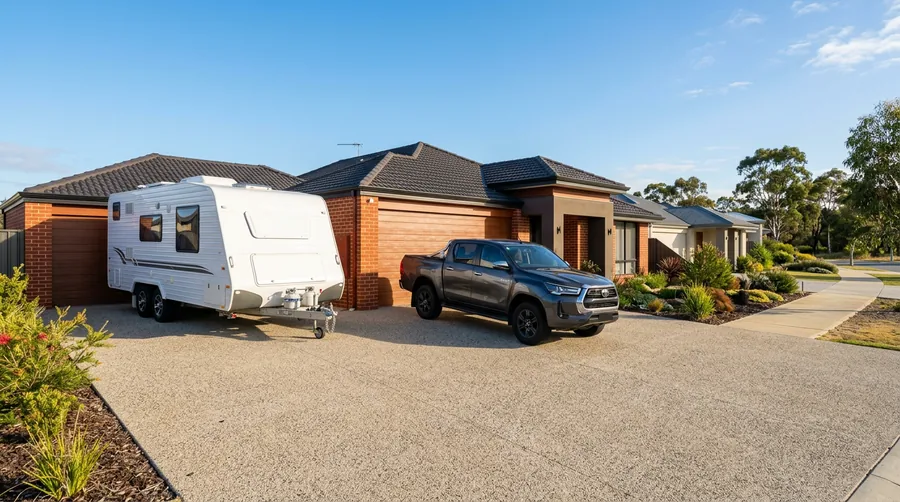
For example, if you plan to store a caravan beside the garage, show the contractor its access route and parking position. Mention any jockey wheel, support legs or other concentrated contact points. Ask whether the proposed design accommodates them.
You can then compare quotes against the same intended use, rather than assuming that each installer has allowed for your plans.
Check the ground beneath the driveway
Before discussing colours, ask how the installer will prepare the ground. CCAA's guidance covers subgrade preparation alongside pavement construction because the slab needs suitable support.
Show your contractor any areas where the old driveway has sunk, where water collects or where previous work disturbed the ground. Tell them about buried services, recent filling or repairs that you know about.
Ask them to explain the preparation they have included and any conditions that could change the scope once they remove the existing surface. This helps you understand a quote that includes excavation and base work, especially when another price appears to cover only the pour.
If you are budgeting for replacement, our breakdown of driveway installation costs explains the broader cost items.
Understand strength, reinforcement and joints
Ask your installer to specify concrete strength separately from thickness. Contractors express compressive strength in megapascals, or MPa; this describes a different property from the slab's depth.
For residential paving, CCAA describes mesh reinforcement as a way to limit the opening of cracks. Adding mesh does not justify reducing the specified pavement thickness.
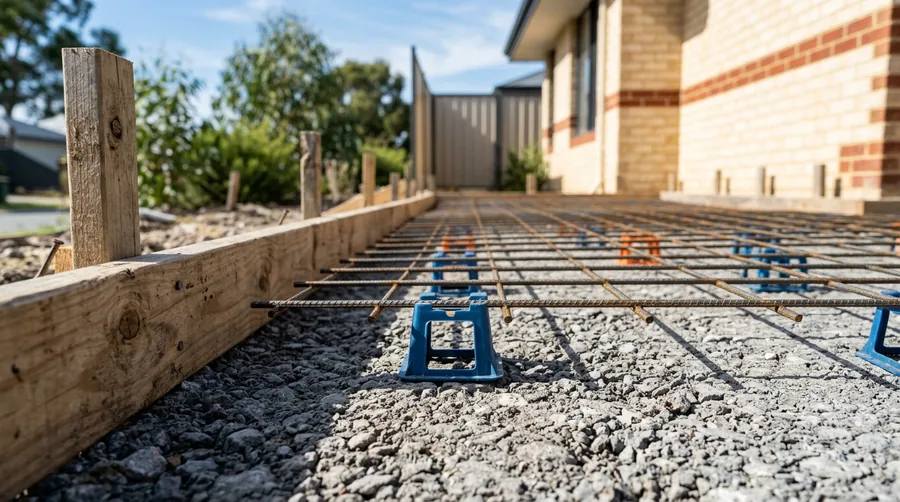
The contractor also needs to plan joints. These include locations for controlled shrinkage cracking and details that allow separation or movement beside other structures. Review the proposed layout before the pour, when you can still discuss how it will look across the driveway.
CCAA's Guide to Concrete Construction provides further background on reinforcement, placing, curing and crack control. Ask your contractor to explain how they will handle those parts of your job.
Check your council crossover requirements
The crossover connects your property boundary to the road across the verge. Your council may specify its construction separately from the driveway inside your property.
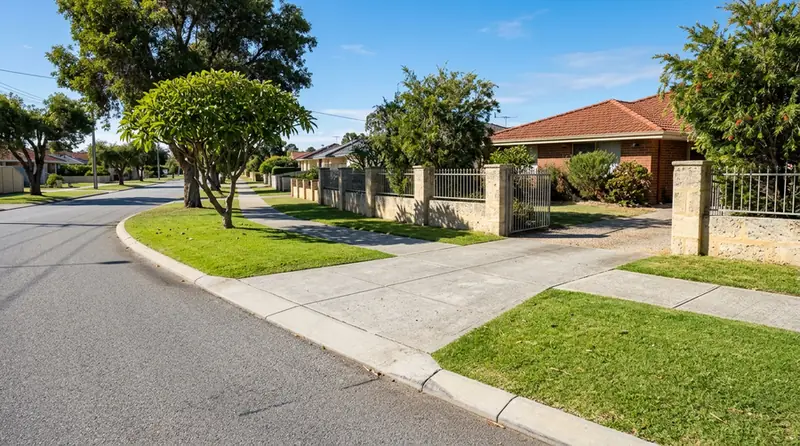
For example, the City of Stirling's residential concrete crossover specification sets a finished concrete thickness of 100 mm, with a stated tolerance. It also requires a minimum 150 mm thickness at the kerb alignment.
That example applies to Stirling's specified crossover work. Check the requirements for your own council, including approvals, dimensions and the treatment of any footpath.
Ask your contractor to identify the crossover as a separate part of the quote so you know who will handle it and what they have included.
Allow for your chosen finish
Choose the decorative finish alongside the construction specification. Discuss your preference for exposed aggregate driveway finishes or another surface before the contractor finalises the work.
Ask them to confirm the specified finished slab thickness and how they will achieve it with your selected treatment. You should be able to compare the appearance, construction details and price together.
Keep the handover instructions as well. Before using the driveway, check the contractor's advice on when new concrete is ready for vehicles.
Compare quotes using the same details
Use these questions when reviewing proposals:
| Quote item | Question to ask |
|---|---|
| Intended traffic | Which vehicles and loads have you allowed for? |
| Slab thickness | What finished concrete thickness are you specifying? |
| Concrete grade | Which strength and mix have you included? |
| Ground preparation | What excavation, removal and base preparation does the price cover? |
| Reinforcement and joints | What have you specified, and where will the joints go? |
| Drainage and crossover | Which works and council requirements have you included? |
| Handover | What curing, access and aftercare instructions will you provide? |
Extra thickness also changes the concrete volume. For a uniform 60 m² slab, 100 mm equals 6 m³ of concrete; 150 mm equals 9 m³. That calculation excludes thickened sections and ordering allowances, but it shows why different specifications affect quantities.
Our guide to questions worth asking a concrete contractor can help you compare the rest of the proposal.
Frequently asked questions
Is 100 mm enough for a driveway?
CCAA recommends at least 100 mm for vehicles under 3 tonnes gross mass. Your contractor must still confirm suitability for your ground conditions, loads and any applicable requirements.
Does a caravan need thicker concrete?
Ask the contractor to assess the caravan's loaded weight, access route and support points. A generic thickness recommendation cannot establish suitability for every caravan and parking arrangement.
Will thicker concrete prevent cracks?
No thickness guarantees a crack-free driveway. Discuss the ground preparation, joint layout, reinforcement and curing as part of the construction plan.
Discuss your driveway with CoastCrete
CoastCrete supplies and installs decorative concrete across Perth, Mandurah and Gingin. Bring your vehicle details, preferred finish and parking plans to the discussion so we can assess the work you need.
Request an on-site driveway quote to discuss your property and proposed installation.
Sources
- CCAA: Residential Concrete Driveways and Paths, August 2026. See page 4 for thickness, reinforcement and joint guidance.
- CCAA: Guide to Concrete Construction, 2020 edition. Background on concrete materials and construction practices.
- City of Stirling: Technical Specifications for Residential Concrete Crossovers, revision dated 6 January 2023. See sections 1.2 and 1.11.
Sources checked on 2 November 2026. Confirm current council requirements and the specification for your property before construction.
About Richard Marsh
Founder · CoastCrete · 20+ years on the tools
Richard founded CoastCrete in Perth after a decade of pouring driveways, alfrescos and pool surrounds across the metro. He writes the articles, answers the calls, and runs the crew personally on every job, so what you read here is the same advice he gives clients on-site every week.
Read more articles by Richard →