
The honest answer (it depends — but here's the math)
Concrete lasts a lot longer than most homeowners think. We get calls every month from people convinced their 12-year-old driveway is "at the end of its life" — when it's actually just due for its first re-seal. The real lifespan depends on three things: the finish you chose, the application (driveway vs alfresco vs pool surround), and how well you've maintained it.
Across our entire Perth client base, the lifespan picture looks like:
- Properly installed + maintained: 30+ years for most finishes.
- Properly installed, minimal maintenance: 15–20 years before significant repair needed.
- Budget install, no maintenance: 8–12 years before visible failure.
- Premium install + active maintenance: 40–60 years before any major work.
“I've got a polished concrete floor in my parents' Subiaco place that's 38 years old. Hasn't had a re-polish in two decades and still looks better than most 5-year-old tile floors. Concrete done right outlasts the people who own it.
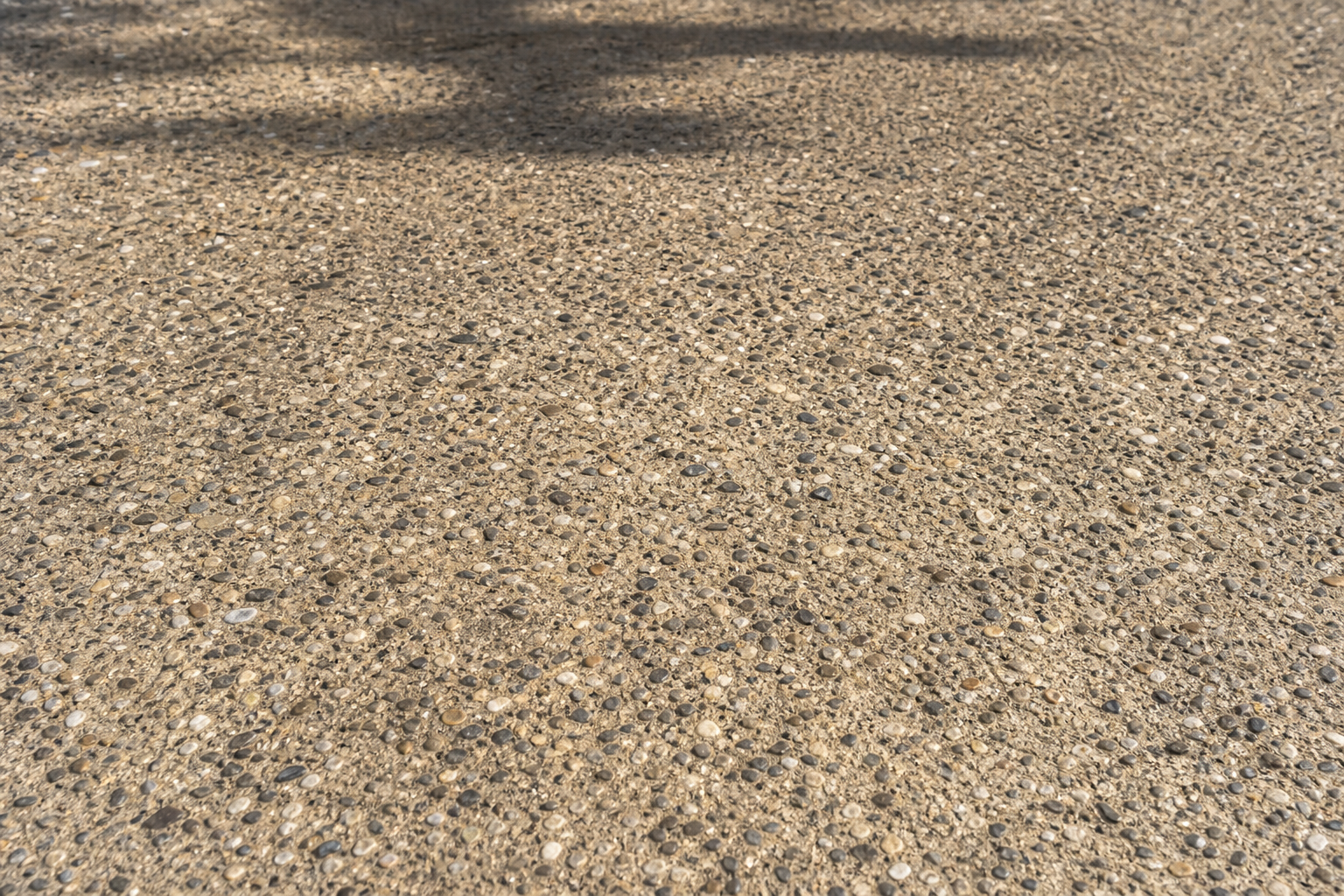
Lifespan by finish type
| Finish | Driveway | Alfresco | Pool surround | Indoor floor | Maintenance multiplier |
|---|---|---|---|---|---|
| Plain broom-finish | 25–30 yrs | 25 yrs | N/A | N/A | +10 yrs with re-seal cycle |
| Exposed aggregate | 25–35 yrs | 25–35 yrs | 25–35 yrs | N/A | +10 yrs with proper seal |
| Liquid limestone | 20–30 yrs (light vehicle) | 25–35 yrs | 25–35 yrs | N/A | +10 yrs with annual rinse |
| Honed concrete | 30+ yrs | 30–40 yrs | 25–35 yrs (varied grit) | 40+ yrs | +15 yrs with re-hone cycle |
| Polished (mechanical) | N/A (indoor only) | N/A | N/A | 30–50 yrs | +10 yrs with re-polish |
| Polished (grind-and-seal) | N/A | N/A | N/A | 15–20 yrs | Re-coats needed every 5–8 yrs |
| Stamped concrete | 20–30 yrs | N/A | N/A | N/A | +5 yrs with active re-seal |
The lifespan figures assume proper original installation and reasonable maintenance. Cheap installs or zero-maintenance setups can fail within half the indicated lifespan.
What kills concrete faster in Perth than elsewhere
Perth's environment is genuinely harder on concrete than most Australian cities. The combination factors that shorten lifespan:
- UV exposure — Perth peaks at UV index 13+ in summer. The world's worst direct UV outside the tropics. Sealer breakdown is faster here than anywhere else in Australia.
- Coastal salt air — properties within 1km of the coast see accelerated sealer breakdown, surface pitting, and reinforcement corrosion if cover is inadequate.
- Saltwater pool chemistry — pool surrounds are constantly exposed to salt + chlorine. Without dedicated sealer maintenance, lifespan halves.
- Temperature swings — summer days at 40°C+ and nights at 22°C create thermal cycling that works the slab harder than most climates.
- Sandy soils — most Perth properties sit on sand. Excellent drainage, but sub-base preparation matters more here because there's no clay binding to hold things still.
- Dry winter — low humidity in winter sucks moisture out of inadequately cured concrete, causing micro-cracking.
- Sprinkler systems — chlorinated reticulation water on outdoor concrete creates etching marks if it pools.
The 7 things that double a slab's life
The maintenance habits that consistently double concrete lifespan in our Perth client base:
DOThe 7 high-impact maintenance habits
- ✓Seal on scheduleThe #1 lifespan factor. Re-seal every 3–5 years for exposed aggregate, every 4–6 for liquid limestone. Skip a cycle = lose 5 years of slab life.
- ✓Annual deep clean before winterPressure wash (max 1,500 psi) every May before the rain arrives. Removes accumulated dirt that holds moisture.
- ✓Joint maintenanceRe-caulk compromised joint sealant every 2 years. Water entry through joints is a silent slab killer.
- ✓Drainage managementDon't let water pool. Stagnant water on concrete = surface degradation. Fix sub-base settlements as they appear.
- ✓Salt rinse for coastal/pool propertiesWeekly fresh-water hose-down during salt season. Salt accumulation on surfaces destroys sealers and concrete itself.
- ✓Treat stains immediatelyOil, rust, organic stains all become harder to remove with time. Same-day cleanup keeps the sealer intact.
- ✓Don't pressure-wash too aggressivelyMore than 1,500 psi strips the sealer. Every aggressive wash costs you 6 months of seal life.
Do all seven and the slab outlasts the house. Skip them and the slab fails halfway through its potential lifespan.
Sealing schedule for maximum lifespan
The sealing schedule by surface and Perth location:
- Exposed aggregate driveway, coastal — re-seal every 3 years.
- Exposed aggregate driveway, inland — re-seal every 5 years.
- Liquid limestone pool surround, saltwater pool — re-seal every 4 years.
- Liquid limestone pool surround, fresh/mineral pool — re-seal every 5 years.
- Honed concrete alfresco — re-seal every 5–7 years.
- Indoor polished concrete — no re-seal, re-polish every 7–10 years.
- Garage floor (polyurethane) — re-coat every 8–10 years.
- Stamped concrete driveway — re-seal every 3–4 years (more aggressive due to colour fade concerns).
For full detail on which sealer for which surface, see our concrete sealer guide.
Signs your concrete is in its final decade
How to read whether your driveway/alfresco/pool surround has 5 years left or 25:
TIPSEnd-of-life indicators
- ✓Multiple joints widening visiblySub-base movement is progressing. Repair buys time but the slab is on the back nine.
- ✓Pitting across more than 30% of surfaceSealer protection is failing and the concrete itself is degrading. 5–10 years from major work.
- ✓Stones falling out across wide areas (exposed aggregate)Cement matrix is failing, not just the surface. Re-seal won't fix this — re-pour ahead.
- ✓Visible reinforcement (rust marks on surface)Reo is corroding from inside the slab. Critical — usually means the slab is at end of life.
- ✓Cracks reopening within 12 months of repairUnderlying movement isn't going to stop. Re-pour planning time.
- ✓Sealer no longer holding 6 months after applicationThe concrete itself has degraded. Sealer can't grip degraded concrete. End-of-life signal.
Most Perth driveways show one or two of these signs in their late 20s. Three or four = re-pour conversation. Five or six = re-pour now.
When to repair, when to replace
Decision framework once you've seen end-of-life signs:
- 1–2 signs, slab under 25 years old → repair + re-seal. Years of life left.
- 3 signs, slab 25–35 years → major repair + full re-seal. Buys 5–10 years.
- 3–4 signs, slab over 35 years → start planning re-pour. The repair work won't pay back.
- 5+ signs, any age → re-pour. The slab has failed structurally.
- Reinforcement visible → re-pour. No amount of surface work will save this.
For more on what we do at CoastCrete and our quality bar, see why choose us and our concrete driveway service. Read our concrete tips for ongoing maintenance guidance, or get in touch for a site visit.
About Richard Marsh
Founder · CoastCrete · 20+ years on the tools
Richard founded CoastCrete in Perth after a decade of pouring driveways, alfrescos and pool surrounds across the metro. He writes the articles, answers the calls, and runs the crew personally on every job — so what you read here is the same advice he gives clients on-site every week.
Read more articles by Richard →Common questions
Can I make my concrete last 50 years?
Yes, with active maintenance — sealing on schedule, joint care, drainage management, salt-rinse for coastal/pool properties. The slab itself can structurally last 60+ years; surface finishes lasting that long need re-polishing or re-honing once or twice in that span.
Does concrete deteriorate faster on the coast?
Yes — properties within 1km of Perth's coastline see roughly 30% faster sealer breakdown, surface pitting and reinforcement corrosion. The fix is more frequent re-sealing (every 3 years instead of 5).
What's the typical Perth driveway lifespan with zero maintenance?
8–15 years before significant surface failure. The slab structure can last longer but the finish degrades, stones come loose, the surface becomes rough and stained. Concrete that's never sealed in Perth ages dramatically faster than you'd think.
Do all concrete finishes age the same way?
No — polished concrete ages best (the polish layer is the concrete itself, not a coating). Honed is next. Exposed aggregate is mid-pack. Stamped concrete ages worst because the pigment is the most vulnerable element.
Is concrete more durable than tile or paving?
Generally yes for the slab portion. Tile and paving need joint maintenance and individual unit replacement over time. Concrete is one continuous surface that ages slowly. Both can last 30+ years with care.
What's the realistic warranty period for Perth concrete?
Reputable Perth concreters offer 5–10 year structural warranty on the slab + sub-base, 1–2 year on finish work. CoastCrete includes a 10-year structural warranty + 24-month finish warranty on every job — see the warranty terms in our quote pack.