
Why exposed aggregate gets dirty faster than plain concrete
Plain concrete has a relatively smooth surface — debris sits on top, gets blown around, and most cleaning is sweep-and-rinse. Exposed aggregate has a textured surface with the stones standing slightly proud. That texture is great for slip resistance and the visual appeal, but it also catches dirt, leaves, sand and organic debris in the gaps between stones.
Once dirt sits in those gaps for a few weeks, it stains the cement matrix between the stones. Once organic debris (leaves, twigs) sits there during wet conditions, it grows algae and embeds. Pressure washing helps but can't reach the deepest gaps without aggressive technique that damages the sealer.
The fix isn't more aggressive cleaning — it's the right cleaning routine done regularly. Less is more.
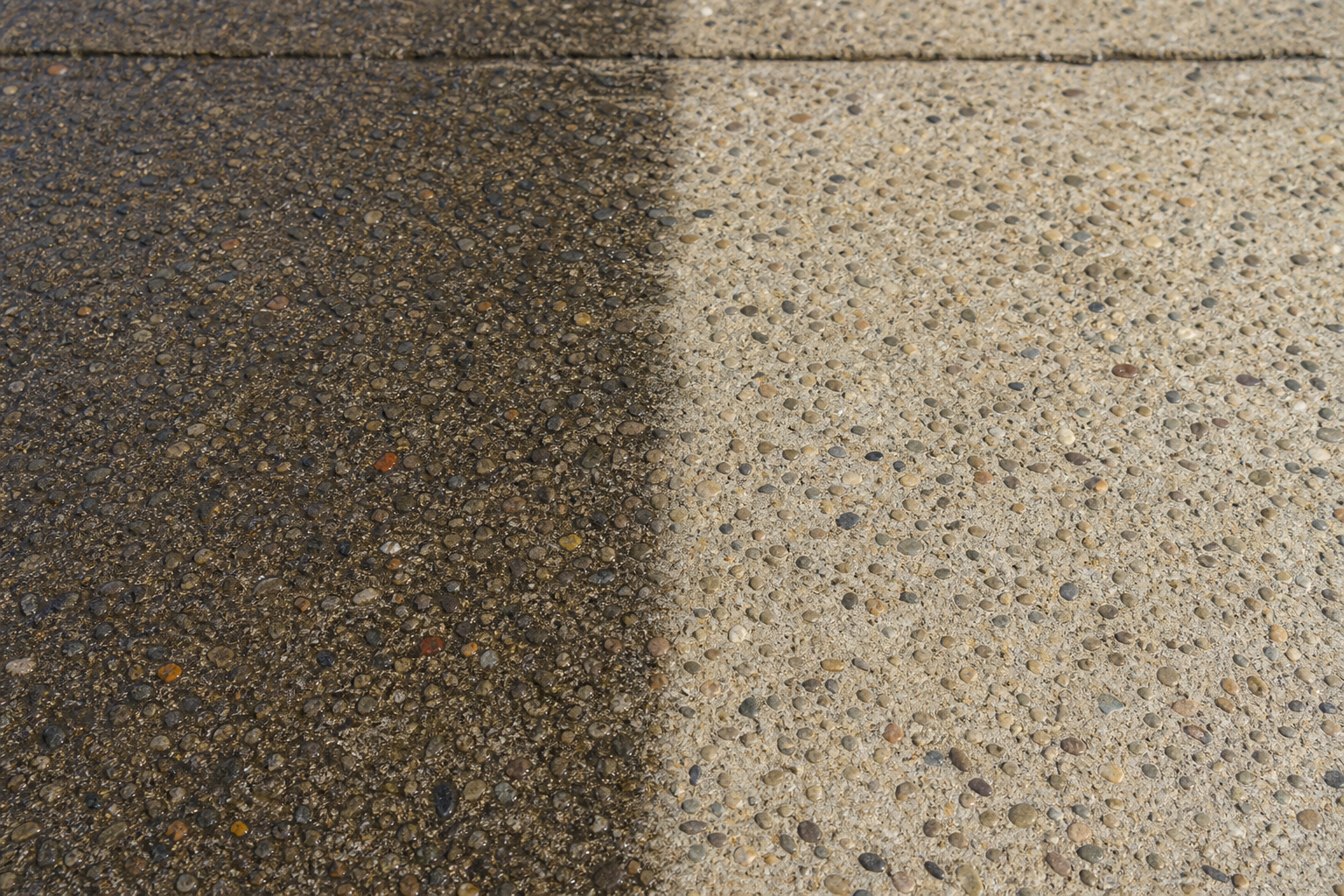
The do's and don'ts of cleaning
DOCleaning that helps
- ✓Soft sweep first — every timeStiff-bristle broom or leaf blower removes the loose debris that pressure washing would otherwise drive into the gaps.
- ✓Pressure wash at 1,500 psi maximumWide fan tip, 300mm distance, broad passes. Sufficient to clean, gentle enough to preserve sealer.
- ✓Oxygen bleach for organic stainsDiluted 1:10 with warm water. Apply, let dwell 10 minutes, soft scrub, rinse. Safe for sealer and stone.
- ✓Mild dish detergent for oil stainsWarm water + dishwashing liquid + soft scrub within 24 hours of spill. Catches the oil before it sets.
- ✓Clear gutters and downpipes draining onto slabConstant runoff = constant staining. Fix the source first.
DON'TCleaning that destroys
- ✗Pressure wash over 2,500 psiStrips sealer in one pass. The sealer protects against everything else — once it's gone, you've started a clock you don't want.
- ✗Chlorine bleach (regular household bleach)Damages cement matrix between stones. Etches the surface. Use oxygen bleach instead.
- ✗Wire brushes on the surfaceScratches the stones and the cement. Use plastic or stiff-natural-bristle brushes only.
- ✗Acid-based concrete cleanersPhosphoric acid (in some 'concrete cleaners') eats the cement. Only use on bare concrete being prepped for new sealer. Never on a finished, sealed surface.
- ✗Leaving stains to setOil after 48 hours requires aggressive cleaning that damages the sealer. Treat within 24 or live with the stain.
Best cleaning method — annual deep clean
The annual deep clean we do on our own driveways every May (before winter rain arrives). Total time: about 4 hours for a 75m² driveway.
- Sweep and blow — remove all loose debris first. Leaf blower if you have one, otherwise stiff broom. Get the gaps between stones cleared.
- Spot-treat stains — oil with dishwashing liquid, rust with rust remover, organic stains with oxygen bleach. Let dwell, scrub gently, rinse.
- Hose down with garden hose — softens accumulated dirt without driving it deeper. Let sit 15 minutes.
- Pressure wash at 1,500 psi — wide fan tip, 300mm distance, work in 1m × 1m sections, broad passes. Don't linger on any single spot.
- Final rinse with garden hose — flush any loosened debris that the pressure washer disturbed but didn't remove.
- Air dry 48 hours before any further work (sealer top-up, etc).
“People look at our annual driveway clean and assume we have some fancy equipment. We don't. It's $300 in supplies and an afternoon. The trick is the routine, not the gear.
Removing oil, paint, rust, leaf stains
| Stain | Safest cleaner | Method | Time required |
|---|---|---|---|
| Fresh oil (under 24 hours) | Dishwashing liquid + warm water | Apply, scrub with soft brush, rinse | 20 min |
| Set oil (over 48 hours) | Degreaser (auto-care, e.g. Simple Green) | Apply, dwell 15 min, scrub, rinse | 30 min |
| Rust (fresh) | White vinegar + scrub | Apply, dwell 5 min, scrub, rinse | 15 min |
| Rust (old) | Oxalic acid rust remover (e.g. Bar Keeper's Friend) | Paste, dwell 10 min, scrub, rinse | 30 min |
| Paint (latex/water-based) | Hot water + dish soap, scrape with plastic edge | Soften, scrape, rinse | 20 min |
| Paint (oil-based) | Mineral turps + scrape | Soften, scrape, dish soap rinse to remove residue | 40 min |
| Leaf stains | Oxygen bleach (1:10 dilution) | Apply, dwell 15 min, soft scrub, rinse | 30 min |
| Pool chlorine bleach marks | Tinted re-seal (no removal possible) | Re-seal the entire affected area | 2+ hours |
Pool chlorine spillage is the stain category most homeowners can't fix — by the time you see the bleach mark, the cement matrix is already etched. The fix is a tinted acrylic re-seal to mask the affected area.
Pressure washing — when it helps and when it ruins
Pressure washing is the most useful and most destructive cleaning tool for exposed aggregate, depending on how it's used.
Helpful pressure washing:
- 1,500 psi or less.
- Wide fan tip (25–40° spray angle).
- 300mm minimum distance from surface.
- Broad, even passes — no lingering.
- Hot water (if your washer supports it) — more effective for oil but no harder on sealer.
Destructive pressure washing:
- 2,500+ psi (most commercial-grade washers).
- Narrow zero-degree spray tips.
- Within 200mm of the surface.
- Holding in one spot to remove a stain.
- Used on areas of compromised sealer — strips remaining sealer with the dirt.
Hire a 1,500 psi unit from Bunnings ($40/half-day) rather than buying or borrowing a 2,500+ psi industrial unit. The lower-spec machine is actually safer for exposed aggregate.
Algae and moss treatment
Algae and moss love exposed aggregate — the texture holds moisture in shaded zones, the cement provides nutrients, and Perth's mild winter creates perfect growth conditions.
- Diluted oxygen bleach (1:10) — apply to affected area, dwell 15 minutes, soft scrub, rinse. Effective for surface algae.
- Wet & Forget — commercial product, longer-lasting (months of effectiveness). Apply and walk away.
- Anti-microbial sealer additives — built into some acrylic sealers. Prevents new growth for 3–4 years per application.
- Improve sun exposure if possible — pruning back overhanging garden reduces shade hours and slows growth.
- Address drainage — water pooling = perfect algae growth. Fix at the source.
Don't use chlorine bleach for algae — it damages the cement between stones. Oxygen bleach is the right answer and safer for sealer.
Re-sealing after a clean
Any deep clean involving pressure washing or aggressive chemical treatment will reduce remaining sealer life by 6–12 months. Re-seal if:
- The water bead test fails (water spreads flat rather than beading).
- The surface looks duller after the clean than you remember.
- It's been more than 3–4 years since the last sealer application.
- You can see chalky-looking patches that weren't there before.
The re-seal should happen 48+ hours after the clean (wait for full surface dry). Two-coat schedule: penetrating siloxane first, acrylic topical second. See our full concrete sealer guide for application detail.
For more on concrete care, see our concrete tips, our exposed aggregate service, or get in touch if you want professional cleaning + sealing as a one-stop service.
About Richard Marsh
Founder · CoastCrete · 20+ years on the tools
Richard founded CoastCrete in Perth after a decade of pouring driveways, alfrescos and pool surrounds across the metro. He writes the articles, answers the calls, and runs the crew personally on every job — so what you read here is the same advice he gives clients on-site every week.
Read more articles by Richard →Common questions
How often should I clean exposed aggregate concrete?
Sweep weekly (or as needed). Light hose-down monthly. Annual deep clean before winter (May in Perth). Spot-clean stains within 24 hours. The deep clean is the big one — skip it and you'll need professional restoration within 5 years.
Can I use a wire brush to remove tough stains?
No — wire brushes scratch the stones and the cement matrix. Use stiff plastic brushes or natural-bristle brushes only. For tough stains, soak the area longer with the appropriate chemical and use a soft brush.
What about graffiti on exposed aggregate?
Soft solvent first (mineral turps for paint, isopropyl alcohol for permanent marker), then dish soap rinse, then assess. If the graffiti penetrated the sealer, you may need a tinted re-seal to mask any residual ghost. We handle graffiti removal as a one-off service if needed.
Can I use steam cleaning?
Yes — steam is gentler than pressure washing and very effective on organic stains. Commercial steam cleaners can be hired from $80/half-day. Particularly effective for chewing gum, sap and stuck-on debris.
Will a deep clean restore faded colour?
Cleaning alone won't restore faded colour. A clean + tinted acrylic re-seal will. The cleaning removes dirt and sealer breakdown; the re-seal restores the visual depth and locks the new colour in.
How do I know if my sealer has worn off completely?
Drop a tablespoon of water on a clean part of the slab. Beads up = sealer still working. Spreads flat and absorbs = sealer compromised, time to re-seal.