
Polished concrete in Perth, why it works (and where it doesn't)
Perth's climate is genuinely suited to polished concrete in a way most Australian cities aren't. The low humidity means moisture doesn't bead on the surface; the high light levels mean the deep sheen actually reads from across the room rather than disappearing in cloudy gloom; and the cooling effect of concrete underfoot is a real advantage from December to March.
Where it doesn't work: wet areas, outdoor zones, any space where someone might be barefoot and wet at once. Polished concrete is glass-smooth and unforgiving when wet. Indoor only, full stop. If you want the look outdoors, see our honed concrete service.
“I've had three clients in a row this year ask for polished concrete in the alfresco. I send them to look at our honed work instead. Same look at eye-level, dramatically different physics when it rains.
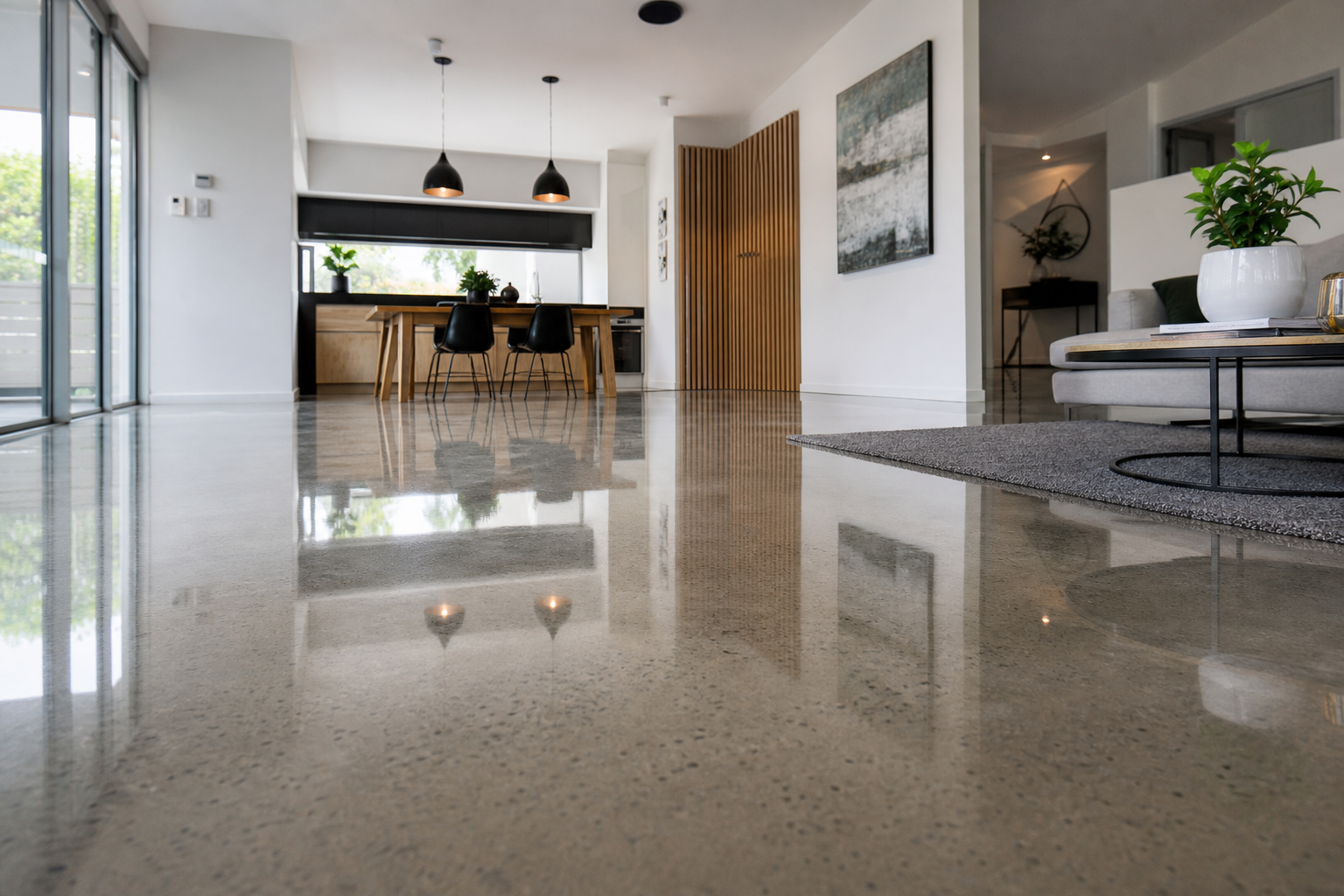
Mechanical polish vs grind-and-seal, the real difference
Two installation methods get called "polished concrete", and they're wildly different. Mechanical polishing uses progressively finer diamond pads (50, 100, 200, 400, 800, 1500, 3000 grit) to grind the concrete itself into a mirror finish. Grind-and-seal uses a single 50–100 grit grind then applies a clear epoxy or polyurethane topcoat that produces a glossy look on top of the concrete.
| Factor | Mechanical polish | Grind-and-seal |
|---|---|---|
| Cost per m² (Perth 2026) | $170–$210 | $95–$135 |
| Finish look | Deep, layered, the concrete is the shine | Glass-on-concrete, surface coating reads as the shine |
| Durability | 30+ years, no re-application | Re-coat every 5–8 years |
| Scratch resistance | Excellent, scratches are in the concrete | Poor, scratches show in the topcoat |
| Heat sensitivity | None | Topcoat can soften under hot pans dropped |
| Repair difficulty | Local re-grind fixable | Sand back full area, recoat |
For a forever home, mechanical polish is the right answer. For a rental, an Airbnb fit-out or a budget-bound renovation, grind-and-seal does the job for less. We quote both honestly so the client can pick. Have a look at our polished concrete examples for both finishes.
Cost of polished concrete in Perth (2026)
Mechanical polish: $170–$210/m² supplied and finished. Grind-and-seal: $95–$135/m². Both prices assume an existing slab in good condition or a new slab poured to a polished-floor spec. Retrofit prep adds $20–$40/m² on top depending on existing slab condition.
The cost variables:
- Final grit, 800 grit is the base finish. 1500 (deeper sheen) adds $15/m². 3000 (mirror) adds $30/m².
- Aggregate exposure, light (cream surface, no stones) is fastest. Medium and heavy aggregate exposure add 1–2 days to the polishing schedule.
- Floor area, under 50 m² jobs carry higher per-m² rates because of equipment mobilisation cost.
- Existing slab cracks, repair before polishing is $50–$200 per crack depending on width.
- Multi-room jobs, through-flowing floors (kitchen-living-dining as one floor) are cheaper per m² than fragmented rooms.
For a 100 m² Perth open-plan home, expect $17,000–$21,000 for mechanical polish, $9,500–$13,500 for grind-and-seal. Three-bed-house full-floor jobs (150–180 m²) drop to the lower end of the range.
Joint placement and cracking, what nobody tells you
This is the single most important section on this page. Concrete cracks. Polished concrete shows the cracks like nothing else, because the cracks read against the deep sheen as dark lines. Joint placement decides where those cracks happen, and once the joints are cut, they're visible forever.
TIPSGood joint planning
- ✓Joints align with architectural linesUnder door frames, at column centres, parallel to walls. The joint reads as a design feature, not a flaw.
- ✓Spacing 3–5m maximumCloser spacing on narrow slabs, wider on big open spaces. Anything over 5m and you'll get random cracking outside the joints.
- ✓Joint depth = 25% of slab thickness100mm slab = 25mm joint depth. This forces the crack into the joint line instead of randomly across the slab.
- ✓Cut within 24–48 hours of pourToo early and the saw chips the edge. Too late and the slab has already cracked elsewhere. Weather-dependent.
DON'TBad joint planning
- ✗Joints crossing the middle of a roomVisible from every angle. Designed by someone who wasn't thinking about how the floor looks.
- ✗No joints at allCracks will happen anyway, but they'll be random and ugly. Skipping joints is a 6–12 month time bomb.
- ✗Inconsistent depths or spacingLooks amateur. Reads as a Tetris board.
- ✗Joints filled with the wrong materialFlexible joint sealant matters, rigid filler cracks out and looks worse than the joint itself.
Lighting, temperature and the polish look
Polished concrete is reflective. That changes how the room feels in a way you can't predict from a sample card. North-facing rooms with lots of glass become bright and crisp, sometimes too bright by midday. South-facing rooms become brighter than expected, the polish bounces what light there is.
Temperature: polished concrete sits at the ambient temperature of the slab, which in summer is 5–8°C cooler than the room. Bare feet in February love this. In winter the floor can feel cold without underfloor heating. We always recommend underfloor heating zones for the main living areas if budget allows.
The aggregate exposure level changes the look more than people expect. Light exposure (only the cement cream shows) reads as a soft monolithic surface. Medium exposure (some aggregate visible) adds depth. Heavy exposure (full aggregate showing) gives a terrazzo-style look, busy and pattern-rich. Look at samples of all three before deciding.
Living with polished floors, dogs, kids, scratches
We get the same questions from every new polished-concrete client: will my dog scratch it, will my kids break their heads, will I have to be precious with it? Short answers: no, no, no.
Polished concrete is harder than tile or hardwood. Dog claws, cat claws, kids' toys, dropped pots don't scratch it. The mirror sheen does show smudges and footprints the same way a marble bench does you'll dust-mop more often than you would on a textured floor.
“The biggest expectation gap I see is around "perfect". Polished concrete is a natural finish, not a fabricated one. The aggregate shows variations. There'll be a hairline at year 5 in the joint line you didn't want it. If you want a perfect floor, buy resin. If you want a real floor that'll outlast you, polished concrete is it.
For families: round dining chairs (felt pads), no metal-castor chairs, leave pet beds in dedicated zones. Apart from that there's no special routine. We've got polished floors in our own homes raising kids and dogs.
Long-term maintenance and re-polishing
Day-to-day maintenance is minimal: dust-mop every few days, damp mop weekly with warm water. No chemicals, no waxes, no sealers needed for mechanical polish. Grind-and-seal needs a re-coat every 5–8 years.
The big maintenance event is the burnish + re-polish at year 7–10. This isn't a fix, it's a renewal. A half-day pass with the 800–1500 grit pads restores the deep sheen and removes any micro-scratches from years of use. Costs $25–$40/m² and brings the floor back to new.
Major repairs (large chips, deep scratches, structural cracking) need a localised grind back to the affected area and re-polish through the grit sequence. Less common than people expect, most floors run 15+ years without major repair.
Common polish problems and how we fix them
The polish problems we get called to fix divide into three categories: substrate issues, polishing issues, and post-install issues. Substrate fixes are expensive; polishing fixes are usually free with the original contractor; post-install is usually a sealer or topcoat issue.
- Dull patches, usually low-grit polishing inconsistency. Local re-polish fixes it.
- Visible scratch lines, grind tracks not lapped properly. Re-grind in the offending area.
- Yellowing on grind-and-seal, UV degradation of the topcoat. Sand back and recoat with UV-stable epoxy.
- Cracks crossing the joint plan, sub-base movement, not surface issue. Investigate the slab; usually means a tracking issue.
- Aggregate "pop-outs", a small piece of aggregate lifts. Local repair with matching aggregate and re-polish.
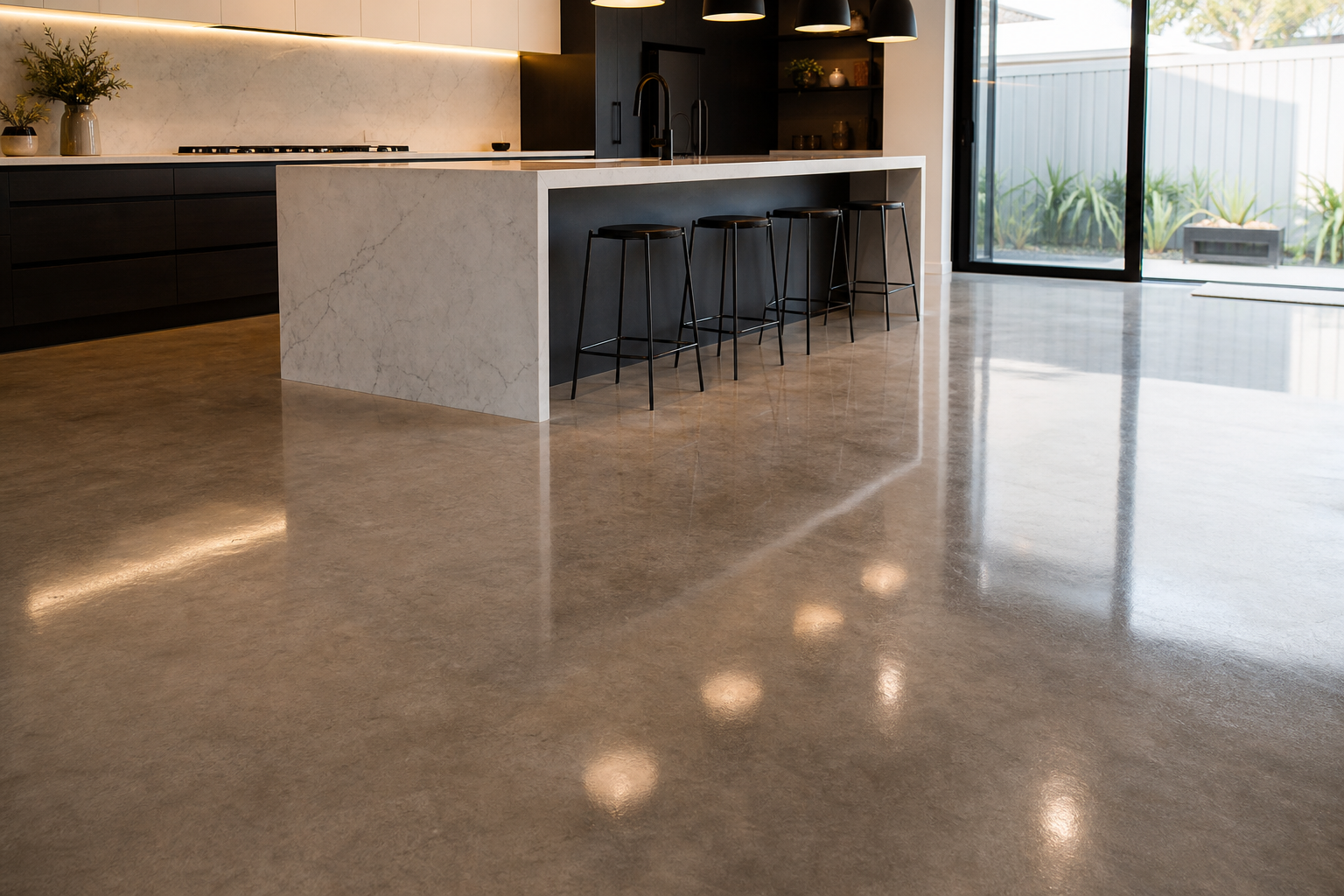
For our process on polished work, see concrete overlay options or get in touch for a quote on your slab.
About Richard Marsh
Founder · CoastCrete · 20+ years on the tools
Richard founded CoastCrete in Perth after a decade of pouring driveways, alfrescos and pool surrounds across the metro. He writes the articles, answers the calls, and runs the crew personally on every job, so what you read here is the same advice he gives clients on-site every week.
Read more articles by Richard →Common questions
Can I polish my existing concrete slab?
Sometimes, depends on the slab's age, mix quality, and surface condition. We test grind a 1 m² patch to see how it responds. Slabs older than 30 years are often not worth polishing; the original concrete just won't take it.
How long does polishing take?
Roughly 1 day per 30 m² for mechanical polish across the full grit sequence. A 100 m² home is around 3–4 working days, plus 24 hours between grit passes for the dust to settle. About a week from start to finish for most jobs.
Is polished concrete bad for resale?
Opposite, high-end buyers actively look for it now. The floor signals quality. The only homes where polished concrete might hurt resale are heritage properties where character carpet/timber is the design language.
Do I need underfloor heating with polished concrete?
Not strictly. Plenty of Perth homes have polished concrete with no heating and live with cold winter mornings. If you're sensitive to cold floors, plan the heating zones with the slab design, much cheaper to install during the build than retrofit.
Can the aggregate be coloured?
Yes, we can specify decorative aggregates (glass chips, coloured stones, white marble) that exposure during the polish. Adds $20–$40/m² depending on aggregate cost.
Will my polished floor look like the showroom samples?
Close, not identical. The aggregate variation is real, every batch is slightly different. Ask the contractor to take a sample core from your actual slab so you can see what your real floor will look like before final polish.