
The decision most Perth homeowners face
For a Perth new build or full kitchen-living renovation, the hard-floor decision usually narrows to polished concrete or tiles. Carpet's out (cleaning, dust, allergens). Timber's out for most living areas (cost, scratching, water sensitivity). Vinyl plank is rising but the high-end Perth market still gravitates to concrete or tile.
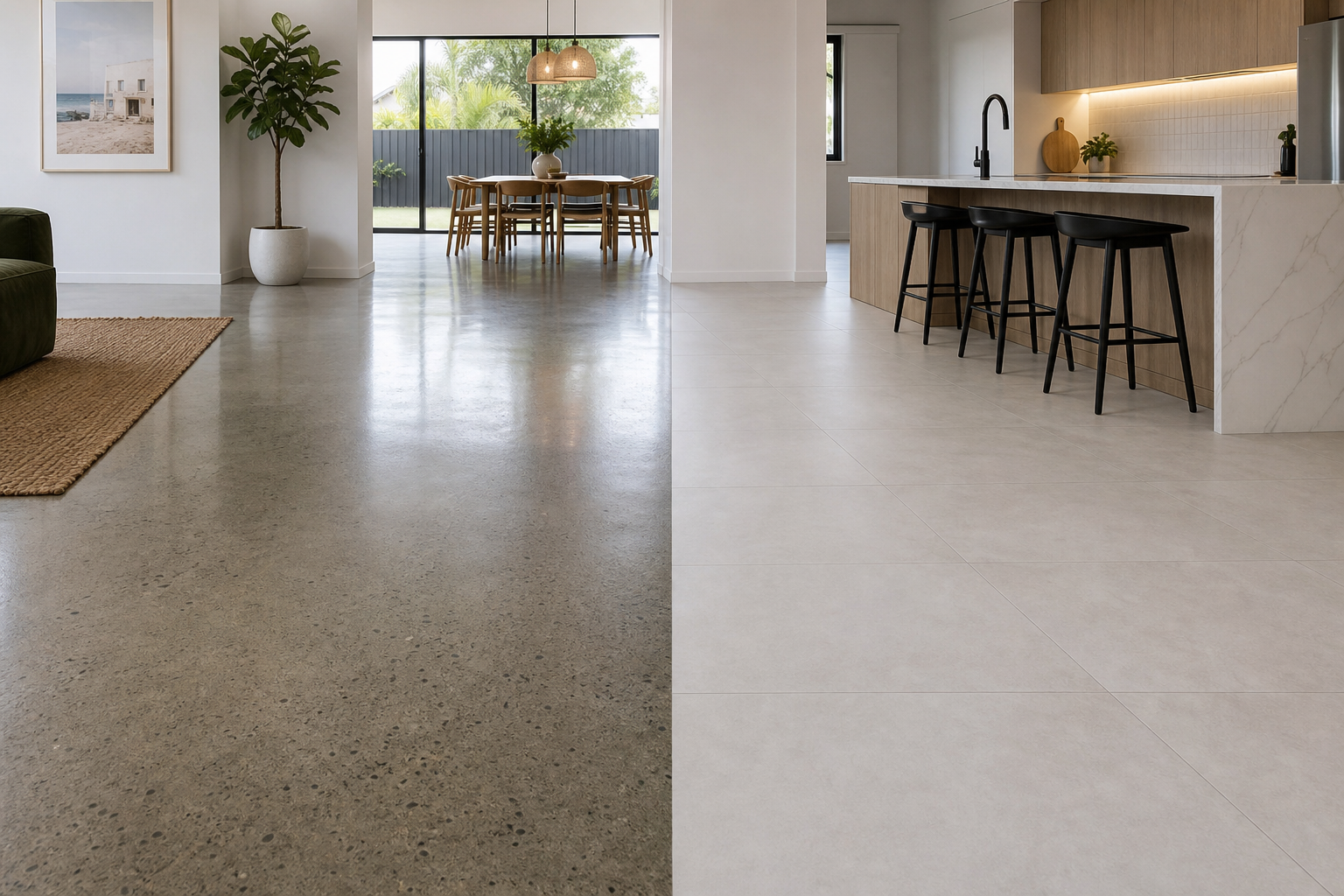
The choice between the two isn't a clear winner — both work. The honest comparison comes down to your priorities: visual continuity vs defined rooms, maintenance burden vs repair flexibility, modern-home read vs traditional read, and the long-term ownership math.
Cost — install + lifetime ownership
| Factor | Polished (mechanical) | Polished (grind-and-seal) | Porcelain tile (mid) | Porcelain tile (high) |
|---|---|---|---|---|
| Install cost per m² (Perth 2026) | $170–$210 | $95–$135 | $120–$160 | $160–$200+ |
| Lifespan | 30+ yrs | 15–20 yrs | 30+ yrs | 30+ yrs |
| Maintenance per year | ~$0 (dust mop) | ~$0 (dust mop) + recoat $20/m² at 7yrs | ~$80 grout cleaning + sealer | Same as mid |
| 20-year ownership cost (100m²) | $18,000 | $15,000 (1 recoat) | $15,000 + $1,500 grout maintenance | $19,000+ same |
| 30-year ownership cost | $20,000 (1 re-polish) | $18,500 (2 recoats) | $15,000 + $2,500 maintenance | $19,500+ maintenance |
Within 20 years polished concrete (mechanical) and high-end tile are roughly equivalent in total ownership cost. Grind-and-seal polished is the cheapest option but needs more frequent re-coats. Mid-range porcelain is the budget option with predictable maintenance.
Longevity — 10, 20, 30 years out
How each floor reads after a decade of real-world wear:
- Polished mechanical at 10 years — still looks new with dust-mop maintenance. Hairline aggregate variations have developed (intentional and natural). Re-polish optional.
- Polished mechanical at 20 years — minor scratches visible in high-traffic zones. Re-polish ($25/m²) brings it back to new.
- Polished mechanical at 30 years — second re-polish keeps the look fresh. Slab still structurally sound for another 30+ years.
- Tile at 10 years — tiles themselves look new but grout shows traffic patterns and discoloration unless aggressively sealed/maintained.
- Tile at 20 years — usually time for a partial re-grout. Individual broken tiles will have been replaced. Often refresh-cleaned annually.
- Tile at 30 years — style date stamp shows. Even quality tile reads as "from a specific era". Some homeowners replace at this point.
“Tile is fashion. Polished concrete is architecture. Pick the floor type that matches your relationship with the room — most people don't realise the difference until they're 15 years in.
Underfloor heating compatibility
Both work brilliantly with underfloor heating. Polished concrete has the edge because the slab itself is the heat carrier — the heating elements warm the entire mass of concrete, which then radiates evenly. Tile transfers heat fast but the grout joints can crack with thermal cycling if installed poorly.
In Perth, underfloor heating is more about winter morning comfort than primary heating — 6–8 weeks of the year it makes a real difference. Both finishes give you the option. Plan it during slab design phase or initial tile install — retrofit is expensive for either.
Sound, comfort, dog-claw scratches
Daily living considerations matter as much as the finish look.
TIPSDay-to-day differences
- ✓Sound: polished is slightly noisierHeels click sharper. Voices reverberate marginally more. Rugs and soft furnishings balance this.
- ✓Comfort: tile slightly warmer barefoot in winterConcrete absorbs the ambient temperature; tile slightly less so. Without heating, both are cold in July.
- ✓Dog claws: neither scratchesBoth surfaces are harder than dog claws. Dogs acclimate to polished concrete reflection faster than expected (1–2 weeks).
- ✓Dropped objects: tile chips, polish doesn'tDropped pots crack tiles. Polished concrete absorbs the impact with a tiny dent at worst. Tile favourable for re-finishing one tile vs concrete locally re-polishing.
- ✓Cleaning: polished is easier (no grout)Sweep, damp mop, done. Tile is easy too but grout requires periodic deep clean.
Repair and replacement — the painful side
This is where the two diverge dramatically in real-world ownership cost.
Tile repair is straightforward but ugly: chip out the broken tile, replace with a matching tile (assuming you saved spare tiles from the original install), re-grout. Result: a slightly-different-looking tile in a sea of matching ones for the next 10 years. Eye goes straight to it.
Polished concrete repair is harder but cleaner: local grind back the damaged area, fill if needed, re-progress through grit sequence, re-polish. Result: an almost-invisible patch if done by someone who knows what they're doing. Eye doesn't catch it.
For large-area replacement (e.g. full kitchen renovation needing different flooring): tile is cheaper to demolish and replace because you're only removing the tiles and grout. Polished concrete is the slab itself, so "replacing" the floor means demolishing the structural slab — usually you'd overlay rather than replace.
Resale value impact
In Perth's modern home market (post-2015 build, contemporary architecture, premium suburbs), polished concrete carries an active premium — buyers see it on the listing photos and it signals quality. Tiles are neutral — accepted but not a feature.
In Perth's traditional / heritage market (federation, character cottages, restored Victorian), polished concrete reads out-of-place. Tiles or timber are the right answer there for resale.
In rentals or investment properties, tiles win — easier turnover, individual replacement, no specialty maintenance knowledge required from tenants.
Which we'd choose for our own home
Honest opinion from the floor we've laid in our own homes:
- Modern open-plan living areas → polished concrete (mechanical). Kitchen-living-dining as one continuous floor. The visual continuity makes the room feel bigger and the architecture more intentional.
- Bathrooms and wet areas → tile. Polished concrete is too slippery wet for safe wet-area use. Even honed concrete needs careful consideration for wet rooms.
- Bedrooms → polished concrete with rugs in winter zones. Or carpet on plywood underlay if you want soft underfoot.
- Hallways and high-traffic → polished concrete every time. Tile grout shows traffic patterns.
- Heritage cottage restoration → tiles (or restored original timber). Concrete is wrong for the architecture.
See our polished concrete service page and concrete overlay service for retrofit options. Drop us a line for a quote.
About Richard Marsh
Founder · CoastCrete · 20+ years on the tools
Richard founded CoastCrete in Perth after a decade of pouring driveways, alfrescos and pool surrounds across the metro. He writes the articles, answers the calls, and runs the crew personally on every job — so what you read here is the same advice he gives clients on-site every week.
Read more articles by Richard →Common questions
Can polished concrete go in the bathroom?
Not really. Polished concrete is glass-smooth and slippery wet — unsafe for bathroom use. For bathrooms we recommend honed concrete or tile. The transition between polished (bedroom) and honed (bathroom) reads as intentional design if done at the doorway.
Is polished concrete bad for elderly residents?
The cold underfoot is the main concern. With underfloor heating, no issue. Slip-rating wise polished is OK dry (it's smooth, not slippery), but wet it becomes risky — so keep the bathroom and wet areas as honed or tile.
Can I get the polished look with the tile flexibility?
Large-format porcelain tiles (1200×600 or 1500×800) come close visually — almost-continuous look, individual replacement. Cost is similar to polished. For modern homes worth comparing both at the showroom.
Does polished concrete crack like grout fails?
Polished concrete cracks at the saw-cut joints if joints are placed properly. The joints are visible (like grout lines) but at much wider spacing (3–5m vs 600mm tile). Random cracks outside joints are a contractor failure.
Which is healthier for asthma / allergy concerns?
Polished concrete wins — no joints, no grout, no places for dust and allergens to hide. Tile is good but grout is the weak point. Carpet is worst (and not in the comparison here).
Can I lay tile over polished concrete later if I change my mind?
Yes — tile-over-concrete is a standard install. The polished surface needs roughing first (grind) for adhesion. So you're committing to one of two endpoints: keep polished, or tile over and forget you ever polished it.