
What honed concrete is, and how it differs from polished
Honed and polished concrete start the same way. The slab is poured, cured for 28 days, then mechanically ground using diamond pads of progressively finer grit. The only difference is where you stop. Polished concrete keeps going all the way to 1500–3000 grit for the mirror sheen. Honed stops earlier, usually between 200 and 400 grit, leaving a smooth, matte, low-glare surface.
That single decision changes a lot. Honed concrete sits at R10–R11 wet (slip-safe outdoors). Polished sits at R9–R10 (slippery wet, strictly indoor-only). Honed shows the aggregate in a soft, scattered way. Polished shows it sharply with a deep reflection.
“Nine out of ten Perth alfrescos I look at want the polished look but really need honed. We pour the same slab, hit it to 400 grit, seal it properly, and it's safe to walk on wet without ever looking tradesman-grade.
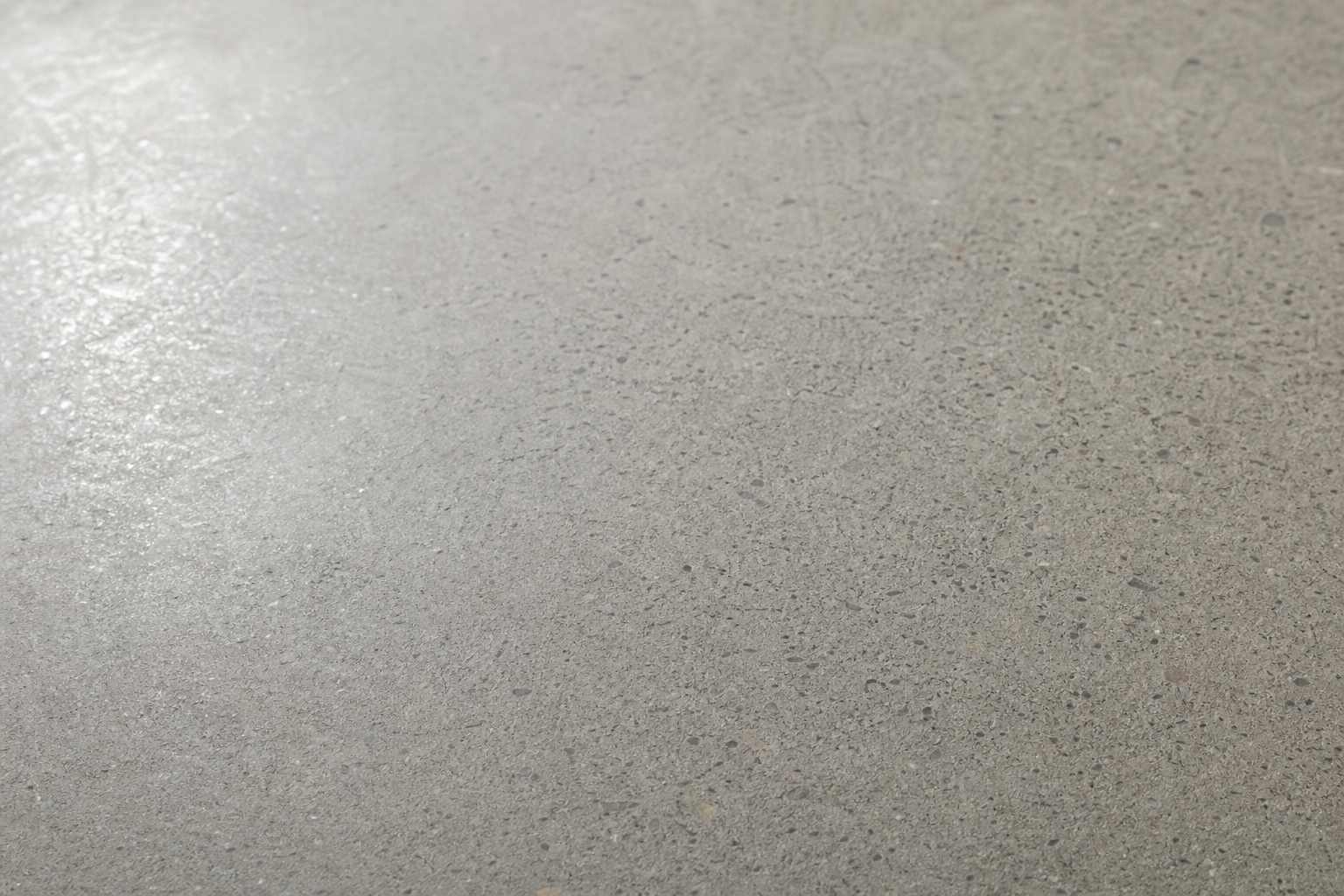
Grit levels and finish options (50, 200, 400, 800 grit)
The grit level is the single biggest finish decision you'll make. Lower grit = rougher feel, more aggregate showing, higher slip rating, more obvious texture. Higher grit = smoother feel, less aggregate showing, lower slip rating, glassier look.
| Grit | Look | Slip (wet) | Indoor | Outdoor | Best for |
|---|---|---|---|---|---|
| 50 | Gritty, aggregate fully exposed | R12 | No | Yes | Industrial, ramps |
| 200 | Matte, sand-paper feel | R11 | Limited | Yes | Pool surrounds, paths |
| 400 | Smooth matte, low aggregate | R10–R11 | Yes | Yes | Alfrescos, bathrooms (most popular) |
| 800 | Silk-smooth, low sheen | R10 | Yes | Marginal | Indoor living, kitchens |
The 400-grit finish is what most Perth homeowners ask for after seeing samples. It's the sweet spot, smooth enough to read premium, gritty enough to stay safe wet. We default to it unless the client has a specific reason for a different grit level.
Cost of honed concrete in Perth
Honest 2026 range: $110–$170 per square metre supplied and laid. That includes the slab, reo, formwork, pour, full grind/hone process and first sealer coat. The cost is higher than exposed aggregate because the honing process is labour-intensive, a 30 m² area takes a day to hone alone, on top of the pour.
- Grit level, 200 grit is at the base price. 400 adds ~$15/m². 800 adds ~$30/m².
- Aggregate exposure level, light aggregate exposure is standard. Heavy exposure (more stones showing) adds ~$10/m².
- Indoor vs outdoor, indoor jobs cost slightly less because access is easier and there's no weather risk.
- Custom colour, pigmenting the mix or applying a tinted seal adds $5–$15/m².
- Retrofit, honing an existing slab is possible but limited by the original mix quality. Adds $15–$25/m² to test, prep and hone.
For a typical Perth alfresco of 40 m², expect $4,400–$6,800 supplied and laid. Pool surround sizes (40–60 m²) sit in the same per-m² range. Indoor living-floor jobs of 80–120 m² often drop to the lower end of the range because of size economies.
Indoor vs outdoor honed concrete
The grit level decides indoor vs outdoor more than anything else. Outdoor jobs need slip-safety in the wet 200–400 grit. Indoor jobs prioritise comfort underfoot and visual sheen, 400–800 grit.
DOIndoor honed concrete works best when...
- ✓The slab is well-pouredIndoor honed shows every imperfection in the underlying slab. Pour quality matters more than for any other finish.
- ✓Joint placement is intentionalSaw-cut joints become a design feature inside, plan them on architectural lines.
- ✓You like a matte lookHoned reads softer than polished. If you wanted the deep gloss, you should be looking at polished concrete.
- ✓Underfloor heating is inHoned concrete carries warmth beautifully, heats up evenly and stays warm.
DOOutdoor honed concrete works best for...
- ✓Alfresco entertaining areasSits flush with indoor flooring, slip-safe wet, looks premium.
- ✓Pool surrounds (with right grit)200–300 grit at the pool edge, then transitions out to 400 grit on the surround. Slip rating where you need it.
- ✓Garage floorsSmooth enough to clean, hard enough to handle vehicle traffic, sealer protects against oil drips.
- ✓Bathroom continuationsMaster bathrooms with seamless flow from bedroom, honed handles both spaces without changing finish.
Slip resistance and pool safety
The Building Code requires R10 wet for residential pool surrounds and R11 for the pool-edge zone (within 500mm of the water). Honed concrete at 200–300 grit hits both requirements comfortably. At 400 grit you're at R10–R11 depending on the aggregate exposure and sealer choice.
Where it gets tricky: clients want the smoother 400+ grit look near the pool. We solve it by varying the grit within the same continuous slab, 200 grit in the pool-edge zone, 400 grit on the surround. The eye reads the whole area as one continuous finish, but the slip rating shifts where it needs to.
For a Perth pool surround, this is what gives you a polished-looking finish that doesn't end up with a kid skidding into the water in February. See our seamless pool edging work for examples.
Sealing requirements for Perth conditions
Honed concrete needs sealing, and the sealer choice matters more than for any other finish because the smooth surface telegraphs every sealer flaw. Wrong sealer, wrong application weather, wrong cure time and you can see the streaks for the life of the slab.
TIPSHoned concrete sealing | what we use
- ✓Penetrating siloxane first coatGoes into the concrete pores, invisible finish, protects against salt and oil. Lasts 5–8 years on indoor floors, 4–6 outdoors.
- ✓Acrylic topical coat for outdoorAdds a subtle sheen, deepens the aggregate colour, adds slip-resistance via micro-grit additive. Re-coat every 4–6 years.
- ✓Hard-wax indoor optionFor indoor honed floors going for the deepest matte luxury look. Solvent-based, plant-derived, food-safe once cured.
- ✓Never solvent-based sealers indoorsVOC release indoors is awful and the fumes linger for weeks. Water-based or hard-wax only inside.
- ✓Apply on dry days, surface temp 15–25°CPerth winter mornings or shaded autumn afternoons are ideal. Avoid summer midday, sealer flashes off too fast and leaves streaks.
Maintenance, repair and re-honing
Honed concrete has the lowest maintenance burden of the decorative concrete finishes, smooth surface, easy to sweep, no joint catchment, no aggregate to trap dirt. The big maintenance event is the re-seal at year 5–7. Apart from that, a damp mop is all you need.
Repair is genuinely easy on honed concrete: a small chip or stain can be ground out locally and re-honed within a 0.5 m² area, then sealed back over. The fix is invisible if matched properly. Compare that to tile (whole tile replacement) or polished concrete (entire room re-polish to match).
Re-honing happens every 15–25 years on heavily-used surfaces. The surface gets a light grind back to 200 grit, then re-progressed through to 400 (or wherever the original finish was) and re-sealed. That gives you another 15–25 years on the same slab.
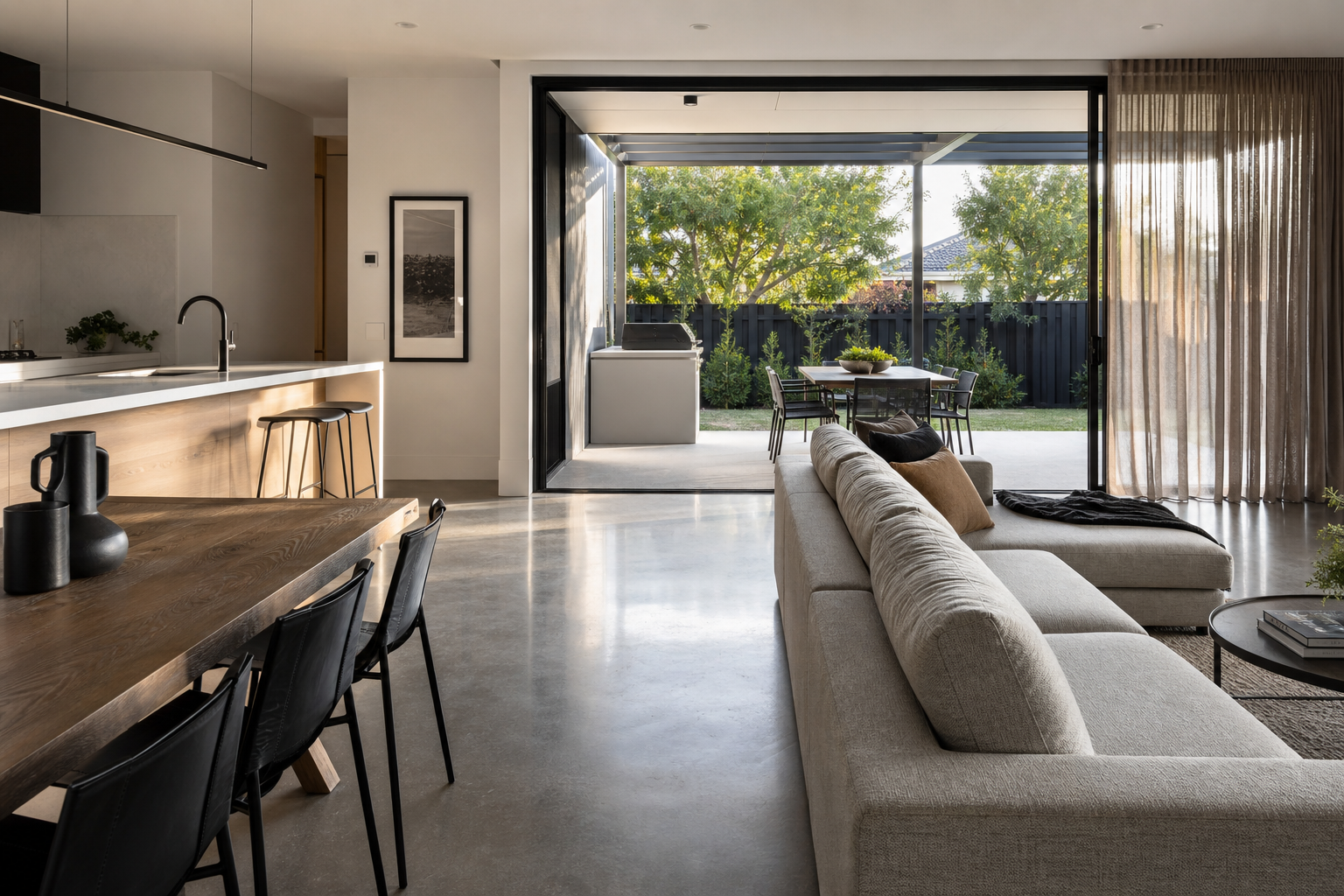
For more on choosing between honed and polished, see our polished concrete service page or read our side-by-side comparison.
About Richard Marsh
Founder · CoastCrete · 20+ years on the tools
Richard founded CoastCrete in Perth after a decade of pouring driveways, alfrescos and pool surrounds across the metro. He writes the articles, answers the calls, and runs the crew personally on every job, so what you read here is the same advice he gives clients on-site every week.
Read more articles by Richard →Common questions
Is honed concrete slippery when wet?
Less than polished, more than exposed aggregate. At 200 grit it's R11 wet (slip-safe). At 400 grit it's R10–R11 with a slip-resistant sealer. At 800 grit it's R10 marginally, outdoor use needs the slip-resistant additive.
Can honed concrete be done over an existing slab?
Sometimes, depends on the original mix, age and condition. We test grind a small area first to see how the slab responds. If the slab is over 30 years old or has poor compaction, retrofit isn't worth it.
How long does the install take?
A 40 m² alfresco runs 1 day prep + formwork, 1 day pour, 28 days cure, 1–2 days honing + sealing. About 5 weeks from start to finish, with 28 of those being the slab curing untouched.
What's the difference between matte and low-sheen?
Matte = 400 grit unsealed or with a hard-wax sealer. Low-sheen = 400 grit with an acrylic topical sealer that deepens the colour. The look is meaningfully different, get a sample of both before deciding.
Can you hone existing exposed aggregate?
Possible but the result is unpredictable. The grind removes the protruding stones unevenly, you end up with a flat surface that shows random patches of aggregate. Rarely worth it. Better to re-pour with a honed-specific mix.
Does honed concrete crack?
All concrete cracks. Properly placed saw-cut joints contain the cracking to the joint lines. We design the joint plan for honed jobs around the floor layout so the joints become a design feature, not a flaw.