
 Exposed Aggregate Concrete
 Honed Concrete
 Polished Concrete
 Liquid Limestone
 Concrete Driveways
 Concrete Alfresco
 Seamless Pool Edging
 Concrete Overlay
 Concrete Table Tops
 Concrete Pump Hire
What liquid limestone actually is, and why Perth homeowners love it
Liquid limestone is the marketing name for a poured concrete mix that swaps a lot of the usual grey cement colouring for crushed Western Australian limestone aggregate and a cream-tinted oxide pigment. It pours, cures and behaves like concrete. The difference is the look: a soft sandstone tone, no aggregate texture, low glare under Perth sun.
It was developed locally, Perth was effectively the first market for it in the early 2000s, because the eastern-states finishes (slate pavers, dark exposed aggregate, bullnose tile) all came with the same Perth problem: they cooked. By midsummer afternoon you couldn't walk barefoot from the back door to the pool.
The light cream colour reflects more solar radiation than dark concrete, the crushed limestone dust takes the edge off the sheen, and a sand-broom surface profile typically sits around R10–R11 wet. Standards Australia guidance recommends higher slip ratings for wet areas such as pool surrounds, so ask your contractor for the tested rating.
“I'll specify liquid limestone around any Perth pool over anything else, every time. It's not the cheapest, but the wife-acceptance factor is unbeatable, and you're not buying ice packs for your dog's paws in January.
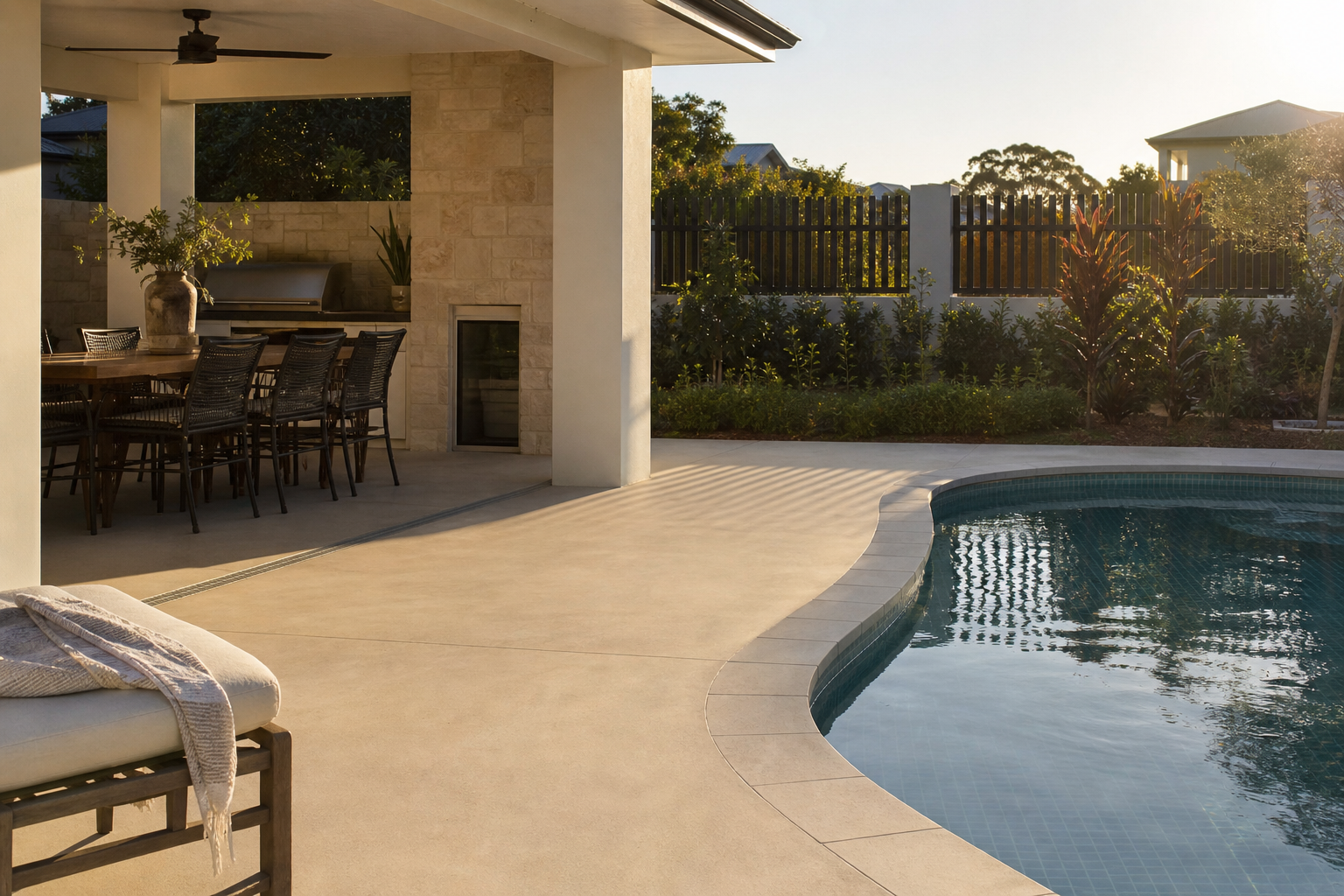
Liquid limestone vs limestone pavers, the Perth comparison
Eight out of ten Perth homeowners considering liquid limestone are also considering limestone pavers, usually the Toodyay or Donnybrook pavers you see in display homes. Both end up cream-coloured. They're completely different products underneath.
Pavers are individual stones, laid on a sand bed or mortar, with joint lines every 300–600mm. Liquid limestone is a monolithic pour, joint lines only where the concreter designed them in, typically along architectural lines or in long, geometric runs.
The choice usually comes down to four things: how the surface feels underfoot, how it handles pool salt rinse, how much it'll cost over 20 years, and how forgiving it is when someone drops a pot plant on it. Read the comparison below before locking in either way.
| Factor | Liquid limestone | Limestone pavers | Exposed aggregate | Plain concrete |
|---|---|---|---|---|
| Cost per m² (2026) | $80–$130 | $140–$220 | $95–$145 | $55–$85 |
| Typical lifespan (good base, maintained) | 25–35 yrs | 30–50 yrs | 25+ yrs | 20–30 yrs |
| Typical slip rating (wet), ask for tested rating | R10–R11 | R11 (most) | R12 (high) | R9–R10 |
| Heat reflection | Excellent | Excellent | Moderate | Poor |
| Maintenance | Reseal per sealer schedule | Re-grout, lift, replace | Reseal per sealer schedule | Reseal per sealer schedule |
Pavers win on flexibility, a damaged paver can be lifted and replaced individually. Liquid limestone wins on the smooth, continuous look and on cost. We've written separately about seamless pool edging, if that's the look you want, pavers can't deliver it.
How much does liquid limestone cost in Perth (2026 pricing)
The honest 2026 range for liquid limestone in the Perth metro is $80–$130 per square metre supplied and laid, before site-prep, formwork or pump hire. That's a real ballpark, not a marketing teaser number, and it covers most residential pool surrounds, alfrescos and courtyards we quote across the metro and the Mandurah corridor.
The variables that move you within the range:
- Access, narrow side gates, second-storey carries or terraced sites push the per-m² up because the pour needs a line pump or wheelbarrow shuttle.
- Size, under 30 m² jobs carry a higher per-m² rate because setup is a fixed cost. Over 80 m² and you usually drop towards the bottom of the range.
- Sub-base condition, a fresh site is cheaper than retrofit (where we have to demolish pavers or rip up an old slab first).
- Colour and finish, straight cream is the base price. Custom pigment blends and trowel-textured finishes add $5–$15 per m².
- Site distance from the plant, north of Joondalup or south of Mandurah usually adds $200–$400 per truck on cartage.
For a typical Perth pool surround of around 45 m², expect $4,500–$5,800 supplied and laid. That's before decorative joint patterns, custom colour, or any retrofit demolition.
“Anyone quoting you liquid limestone at $60/m² is either green, cutting the mix, or planning to slip extras into the final invoice. The honest 2026 floor in Perth is $80, and you should know what you're paying for before the trucks roll up.
Site-specific factors change every quote, slab thickness, reinforcement spec, drainage falls and edge treatment all sit outside the per-m² rate. Get the quote in writing with the inclusions list. See our concrete process for what a full scope looks like.
Where liquid limestone works best, and where it doesn't
The application list isn't glamorous but it matters more than the colour swatch. Liquid limestone is brilliant in some places, average in others, and a poor choice in a few. Here's where we use it and where we steer clients elsewhere.
DOWhere liquid limestone shines
- ✓Pool surroundsThe original use case. The light colour stays cooler in the sun than dark finishes, it can be made more slip resistant, and it resists chlorine when sealed.
- ✓Alfresco entertaining areasEspecially north-facing alfrescos that catch the full afternoon sun. The cream colour reflects heat the way slate or dark tile can't.
- ✓Shaded courtyardsThe smooth, continuous look reads premium and the maintenance is minimal.
- ✓Pathways alongside poolsCan be made more slip resistant, with a continuous edge to the pool surround and no paver gaps to catch leaves.
DON'TWhere to choose something else
- ✗Heavy-vehicle driveways4WDs, dual-cab utes and boat trailers will mark up the surface over time. Use exposed aggregate or honed for driveways.
- ✗Indoor floorsLiquid limestone is designed for outdoor use. Indoor floors should be honed or polished concrete.
- ✗Cold-corner shaded areas with no UVAlgae and moss love cream concrete that never dries out. If the spot stays wet, choose a finish with more grip, such as exposed aggregate, and ask for its slip rating.
On a typical Perth backyard renovation, we'll often combine: liquid limestone for the pool surround and alfresco, exposed aggregate for the driveway and side passage. The look is consistent enough to read as one design and each finish lives in its right job. Have a look at our exposed aggregate work for what the driveway side of that looks like.
Colour and texture options available in Perth
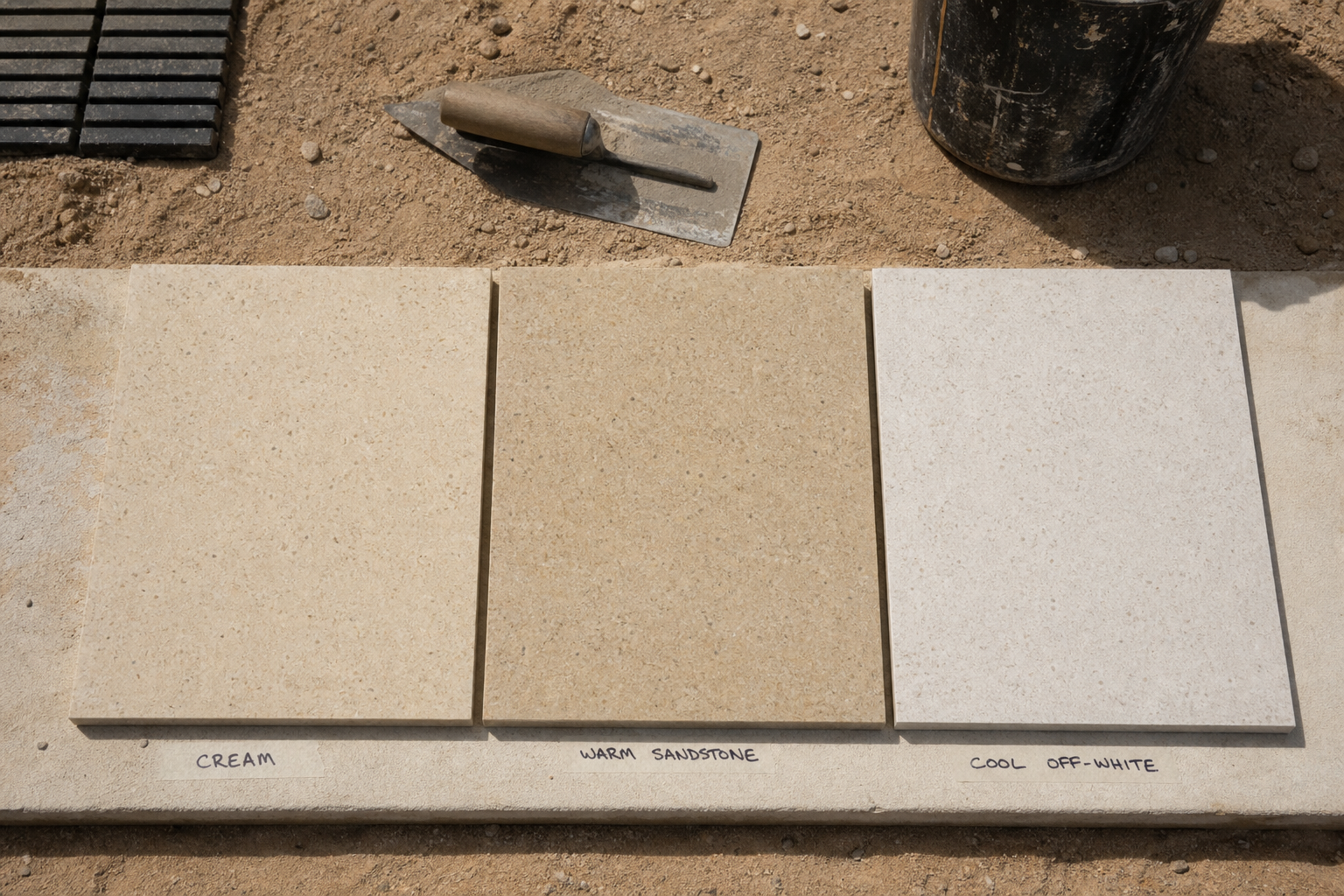
The base liquid limestone colour is a clean cream. From there, you can shift it warmer (sandstone), cooler (off-white), or push toward grey-cream (modern). We work with two main local suppliers for pigments and the palette runs about 14 stock tones with custom blending available for an extra charge.
Texture has more impact than people expect. The standard trowel finish has a fine sand-broom texture that takes away the cement sheen. Other options:
- Steel trowel, smoother, slightly higher sheen, typically around R10. Best in covered alfrescos.
- Sand-broom, standard, typically R10–R11. Most pool surrounds.
- Heavy broom, coarse texture, typically R11–R12. Steeper slope, ramps, fully exposed.
- Salt finish, light pock-marking from rock salt pressed into the wet surface. Adds visual interest and improves grip.
Always look at a 1 m × 1 m sample panel before locking in colour and texture. The cream you see on a 100mm sample card looks dramatically different across a 60 m² alfresco. Most Perth supply yards have full-size sample panels, or we'll bring one to your site on the quote visit.
For the full palette including warm and cool variants, see the Limecrete colour range on our site.
Sealing, maintenance and lifespan in Perth's coastal climate
Laid on a well-prepared base, liquid limestone typically lasts 25–35 years in Perth, and the sealer is a big part of that. Get the sealer right and maintenance stays light until the first reseal is due. Get it wrong (skip it, use the wrong sealer, or apply at the wrong time) and you'll regret it before your second summer.
We use a penetrating siloxane sealer for the first coat, followed by a topical acrylic at year three for pool surrounds and alfrescos. The penetrating sealer stays inside the concrete and resists salt; the topical renews the colour and, with a grit additive, can make the surface more slip resistant.
TIPSLiquid limestone maintenance | annual checklist
- ✓Soft wash, not pressure washA standard garden hose plus a soft-bristle deck brush, every 6–8 weeks during pool season. Pressure washers above 1,500 psi can lift the sealer.
- ✓Salt rinse weekly during summerPool-surround salt loves to dry on the surface and crystallise. A 30-second rinse with a regular hose pushes it back into the soak-away.
- ✓Treat algae early, not lateFirst sign of green or black spotting, diluted oxygen bleach (not chlorine) plus a soft scrub, hose down. Don't let it embed for a month.
- ✓Reseal on scheduleHow often depends on the sealer: as a guide, a topical sealer every 2 to 5 years and a penetrating sealer around every 5 to 7. Watch for water beading. Once water spreads flat instead of beading on the surface, the sealer has worn, so book a reseal.
- ✓Spot-fix surface chips immediatelyConcrete chips happen, pot plants, dropped tools. Patching kits are $40 and take 20 minutes. Leaving the chip lets water track underneath.
Coastal Perth properties, Cottesloe, Scarborough, Hillarys, Mindarie, usually need their first re-seal a year earlier than inland because salt air accelerates sealer breakdown. Same for any property within 1.5km of the coast. Inland properties (Joondalup, Subiaco, anywhere east of West Coast Highway) hold the original sealer longer.
Common liquid limestone installation mistakes to avoid
We get called out to repair other people's liquid limestone work more often than we'd like. Most of the call-outs trace back to one of five mistakes, and they're all avoidable if you know what to look for in your contractor.
DON'TWatch for these in any liquid limestone quote
- ✗Pouring without a proper sub-baseLiquid limestone needs the same compacted road-base + reo as standard structural concrete. If they're saying 'just pour on the sand', walk.
- ✗Skipping control jointsSaw-cut joints at the right spacing make cracking follow the joints rather than wander across the slab. Inexperienced concreters either skip them or cut them in the wrong places.
- ✗Sealing too earlyFirst seal happens after 21–28 days minimum, depending on weather. Sealing at day 7 can trap moisture and cause blistering within a couple of months.
- ✗No drainage planningLiquid limestone needs a 1:80 minimum fall away from the house. Flat-laid surrounds pool water and the algae problem starts there.
- ✗Cheap pigment blendsThe mid-range supplier pigments fade unevenly under Perth UV. Specify the tinting brand in the contract or you get whatever was cheapest that week.
We use a structured pre-pour and post-pour checklist on every job, sub-base, reo, joint plan, drainage falls, finish sample, sealer schedule. Ask any contractor for theirs. If they shrug, that's your answer. Here's how we work if you want to compare it to other quotes you're looking at, or drop us a line for a site visit.
Planning a job like this? Our installation pages for liquid limestone and seamless pool edging explain how we lay it, what is included and how our free on-site quote works. You can also see photos from our customers' own jobs.
About Richard Marsh
Founder · CoastCrete · 20+ years on the tools
Richard founded CoastCrete in Perth after a decade of pouring driveways, alfrescos and pool surrounds across the metro. He writes the articles, answers the calls, and runs the crew personally on every job, so what you read here is the same advice he gives clients on-site every week.
Read more articles by Richard →Common questions
Can liquid limestone be used over an existing concrete slab?
Yes, as a thin (15–25mm) overlay if the existing slab is structurally sound and properly prepared. We use a bonding primer between the layers. If the existing slab has structural cracks or is older than 25 years, we usually recommend a full demolition and re-pour instead.
How long does liquid limestone take to install?
A typical 45 m² pool surround takes 1 day for prep and formwork and 1 day to pour. As a guide, light foot traffic is fine after about 24 to 48 hours, but it needs about 21 to 28 days of curing before sealing, so plan on about four weeks before full pool-surround use. Timings depend on weather and mix.
Does liquid limestone stain easily?
Less than untreated concrete because the cream colour hides most stains, but oil, rust and pool chemicals will still mark it if left to sit. Spot-clean immediately and reseal on schedule, and the surface should keep looking good between reseals.
Will it crack?
Concrete shrinks as it cures, so fine hairline cracks can appear in any slab, including liquid limestone. Saw-cut control joints are placed so that cracking follows the joint lines, where it is far less noticeable. Wider or moving cracks, or cracking well outside the joint plan, usually point to badly placed joints or a sub-base or reinforcement problem.
Can I DIY install liquid limestone?
Not realistically. The mix needs a specific dosage of limestone aggregate, the pour window in Perth heat is narrow, and the trowel-finish technique takes years to read properly. We've seen DIY attempts and they almost always end up needing professional re-pour within 18 months.
Is it safe around saltwater pools?
Yes, when correctly sealed. Salt is the biggest enemy of any decorative concrete, but a quality penetrating sealer, resealed on schedule, plus regular rinsing handles Perth saltwater pools well.