
The pool-surround decision in Perth
Eight out of ten Perth pool builds end up at this same crossroads. The client knows they don't want dark concrete or slate (cooks). They've seen liquid limestone in other Perth homes and they've seen Toodyay or Donnybrook limestone pavers in display homes. Both look cream. Which one?
The honest answer: both work brilliantly when done properly. The choice comes down to four things — the look you want (continuous vs jointed), the repair flexibility (can-replace-individually vs not), how the salt rinse routine fits your maintenance schedule, and the upfront cost.
We've installed thousands of square metres of both around Perth pools. Here's the honest comparison.
Liquid limestone — pros and cons
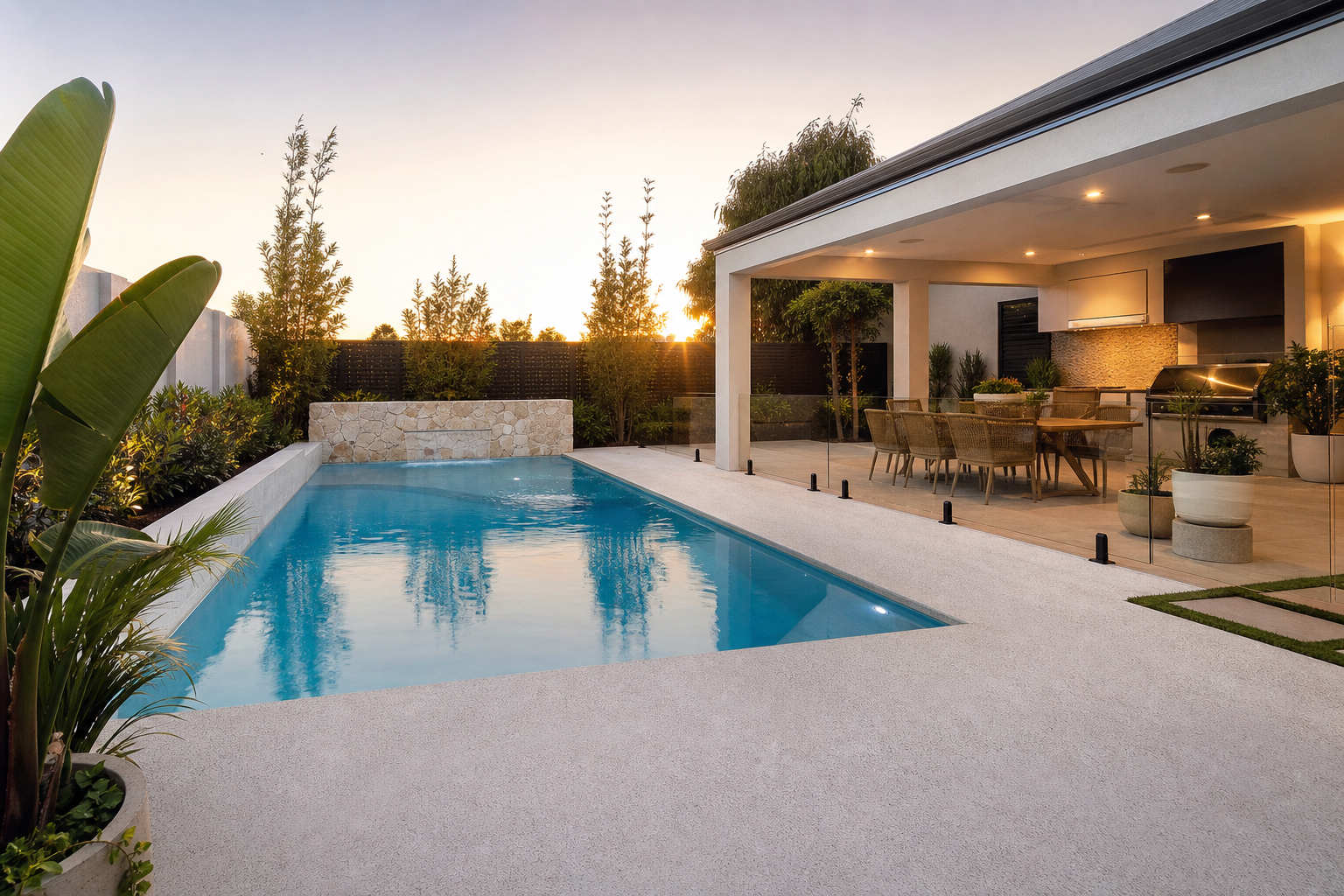
Liquid limestone is the monolithic pour. One continuous surface, joints only where the concreter designed them in (typically every 3–4m along architectural lines). The look reads modern and clean.
DOWhy pick liquid limestone
- ✓Continuous lookNo joint lines breaking up the surround. Especially good with infinity-edge pools or curved pool shapes.
- ✓Lower install cost$80–$130/m² vs $140–$220/m² for pavers. Roughly 40% cheaper for similar finished look.
- ✓No joint sand washing outPool salt rinse doesn't wash out joints because there are no joints to fill with sand.
- ✓Faster installPour and finish in 1 day vs paver laying that takes 2–3 days for a typical surround.
DON'TWhere liquid limestone struggles
- ✗Repair is harderSpot-repair of liquid limestone is visible. Match colour is approximate at best. Pavers can be lifted individually and replaced.
- ✗Lifespan slightly shorter25–35 years vs 30–50 years for pavers. Real-world difference: one extra re-seal cycle in your lifetime.
- ✗Surface chips show moreA dropped pot plant creates a visible chip. Pavers handle dropped objects better.
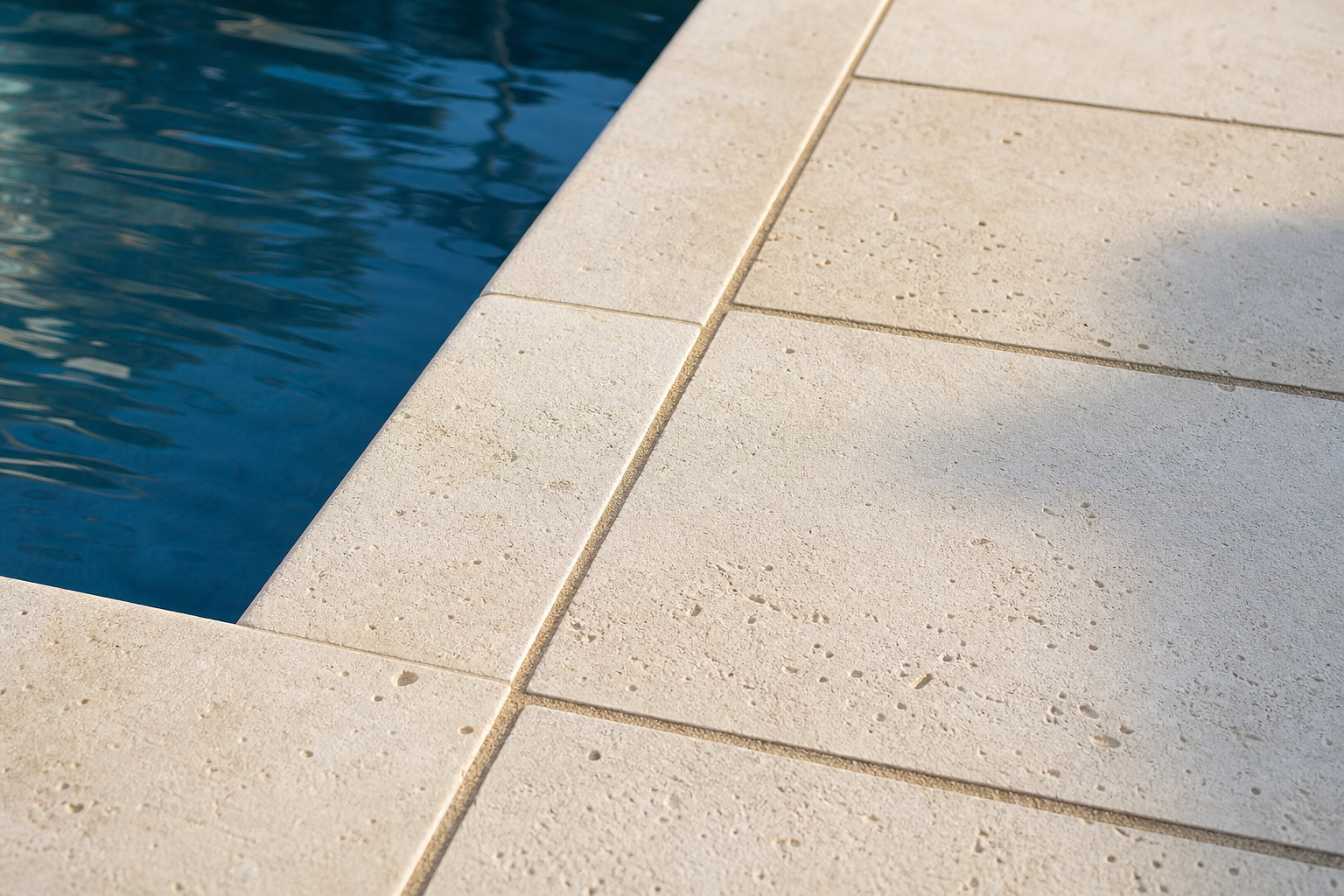
Traditional limestone pavers — pros and cons
Limestone pavers are individual cut stones laid on a sand bed or mortar base. The joint pattern is the look — typically 5–10mm joints between stones, sand-filled or mortar-filled.
DOWhy pick limestone pavers
- ✓Repair flexibilityDamaged paver? Lift it, replace it, done. The most repairable surround option available.
- ✓Longer lifespan30–50 years vs 25–35 for liquid limestone. The stone itself doesn't degrade — only the joints need attention.
- ✓Slightly cooler underfootAir gaps between stones reduce heat retention. Measurable but small (2–3°C cooler at peak sun).
- ✓Drainage flexibilitySurface water drains between stones if you've set the sub-base to allow it. Less risk of pooling.
- ✓Traditional luxury lookIf the rest of the house is Hamptons, French Provincial or coastal European — pavers fit the aesthetic better.
DON'TWhere pavers struggle
- ✗Joint sand washes out under pool salt rinseAnnual re-sanding required. Skip a year and the joints destabilise.
- ✗Weeds grow in jointsWithout diligent joint sealing, weeds get a foothold. Inevitable on any paver job over 5 years.
- ✗Higher install cost40% more than liquid limestone for similar finished look. Sometimes worth it, sometimes not.
- ✗Individual pavers can liftSand-bed pavers shift over time. Mortar-set pavers don't lift but don't drain either.
Cost comparison per m²
| Factor | Liquid limestone | Limestone pavers (sand-bed) | Limestone pavers (mortar-set) |
|---|---|---|---|
| Cost per m² (Perth 2026) | $80–$130 | $140–$180 | $180–$220 |
| Lifespan | 25–35 yrs | 30–40 yrs | 40–50 yrs |
| Salt resistance | Excellent with sealer | Stone OK, joints poor | Excellent |
| Heat (peak summer surface) | ~40°C | ~38°C | ~38°C |
| Slip rating (wet) | R10–R11 | R11 | R11 |
| Maintenance per year | Re-seal at year 4–6 | Joint sand top-up annually | Re-grout 8–10 yrs |
For a typical 45m² Perth pool surround, you're comparing $3,600–$5,800 (liquid limestone) to $6,300–$9,900 (limestone pavers). The cost gap pays for itself over 30+ years if pavers last and you maintain them — but only if you maintain them.
Heat reflection — measured in Perth summer
We've taken surface temperature readings of both finishes at the same Perth pool installation on 38°C summer days. Direct sun, no shade, mid-afternoon. The results:
- Liquid limestone — 40–42°C surface temperature.
- Limestone pavers (sand joints) — 38–40°C surface temperature.
- Dark exposed aggregate (comparison) — 55–60°C surface temperature.
- Slate paving (comparison) — 60–65°C surface temperature.
Both cream limestone options stay walkable barefoot in direct Perth sun. The pavers come out 2–3°C cooler because the air gaps between stones reduce heat retention. Both are dramatically better than dark concrete or slate.
“For 80% of Perth pool surrounds the heat difference between liquid limestone and pavers isn't noticeable to bare feet. Both are cool. Pick the look you want, not the 2 degrees.
Slip resistance and pool-safety standards
The Building Code requires R10 wet for residential pool surrounds and R11 for the zone within 500mm of the water edge. Both liquid limestone (sand-broom finish) and limestone pavers hit R11 wet — both safe by code.
The trickier zone is the actual coping (the edge of the pool itself). Both options handle this; we typically use a tile or bullnose paver right at the waterline, then liquid limestone or paver immediately behind it for the surround.
For wheelchair or accessibility considerations, liquid limestone is the better choice because it's continuous and rolls without joint bumps. Pavers can be uncomfortable on small wheels (prams, wheelchairs) over time.
Joint placement, cracking, salt damage
Three areas where the finishes diverge most:
Joints. Liquid limestone has wide-spaced saw-cut joints (3–4m) that read as subtle lines. Pavers have continuous joint patterns at 300–600mm. Visually different — the eye reads liquid limestone as a continuous surface and pavers as a pattern.
Cracking. Liquid limestone cracks at the joint lines if joints are placed properly. Random cracking outside joints is a contractor failure. Pavers don't crack — individual pavers might chip or break (lift and replace), but the surround as a whole doesn't crack.
Salt damage. This is the big one for Perth pools. Salt water + chlorine + Perth UV attack both finishes constantly. Liquid limestone needs a quality penetrating sealer + annual rinse. Pavers need the joints maintained (sand top-up annually for sand-bed, re-grout 8–10 yrs for mortar-set).
Which we recommend (and when)
Honest recommendation framework:
TIPSLiquid limestone when...
- ✓You want a continuous monolithic lookModern architecture, curved pool shapes, infinity-edge pools, indoor-outdoor flow.
- ✓Budget is a factor40% cheaper installed, identical visual cream tone, indistinguishable from 3m away.
- ✓You're OK with 25–35 year lifespanWhich is realistically as long as you'll own the house or maintain the pool.
- ✓You'll commit to the annual rinse + re-sealSkip the maintenance and the lifespan drops fast.
TIPSLimestone pavers when...
- ✓The architecture demands jointed patternHamptons, French Provincial, traditional luxury homes.
- ✓Repair flexibility mattersFrequent furniture changes, heavy outdoor entertaining, dogs running across the surround.
- ✓Long-term ownership is the plan30–50 years of ownership with proper maintenance, the paver cost-amortisation works.
- ✓Joint maintenance fits your routineIf you'd rather top up sand annually than re-seal every 5 years.
For our liquid limestone work, see the service page. For our seamless pool-edge concrete work, see seamless pool edging. For the colour range, see Limecrete colour range.
About Richard Marsh
Founder · CoastCrete · 20+ years on the tools
Richard founded CoastCrete in Perth after a decade of pouring driveways, alfrescos and pool surrounds across the metro. He writes the articles, answers the calls, and runs the crew personally on every job — so what you read here is the same advice he gives clients on-site every week.
Read more articles by Richard →Common questions
Can I mix liquid limestone and pavers in the same surround?
Yes — common solution: pavers at the coping (the waterline edge) for repair flexibility, liquid limestone for the wider surround. Best of both. Adds about $20–$30/m² to the surround for the coping line.
Which is better for saltwater pools specifically?
Both work — liquid limestone slightly easier because there are no joints to wash out. Pavers work but the joint maintenance is more involved with saltwater. Mortar-set pavers (not sand-bed) for saltwater pools.
What if my existing pool surround is bad — repair or replace?
Liquid limestone: if more than 30% damaged, replace. Pavers: if more than 50% damaged, replace. Otherwise spot-repair makes more financial sense. We always quote both options at the site visit.
Do pavers need a concrete base underneath?
Sand-bed pavers sit on a 30–50mm sand layer over compacted road-base. Mortar-set pavers sit on a concrete slab + mortar bed. Mortar-set is more permanent but loses some drainage flexibility.
Will liquid limestone fade in 5 years like cheap pavers?
Quality pigment with proper sealer schedule — no, the colour stays through 5 years easily. Cheap pigment + skipped sealing = visible fade by year 3. The pigment brand specified in your contract matters.
Can I DIY install pavers?
Possible but takes practice. The sub-base prep and joint sand work need to be right or the pavers move within a year. For pool surrounds we'd recommend professional install on either option because the falls toward the pool need to be exact.